
15 Min Read

Vlad Zghurskyi
Content Creator
Token launches no longer generate secondary market liquidity. Fundraising no longer follows visibility or reach. And market pricing has decoupled from underlying business performance.
15 Min Read
Vlad Zghurskyi
Content Creator
Token launches no longer generate secondary market liquidity. Fundraising no longer follows visibility or reach. And market pricing has decoupled from underlying business performance.
These shifts didn’t happen overnight, but 2025 made them impossible to ignore. So what exactly happened, and what should you be doing in 2026? Let's find out.
People like to assess 2025 as “just a down year.”
Well, we can say it wasn’t much of a cycle dip, but rather a structural failure.
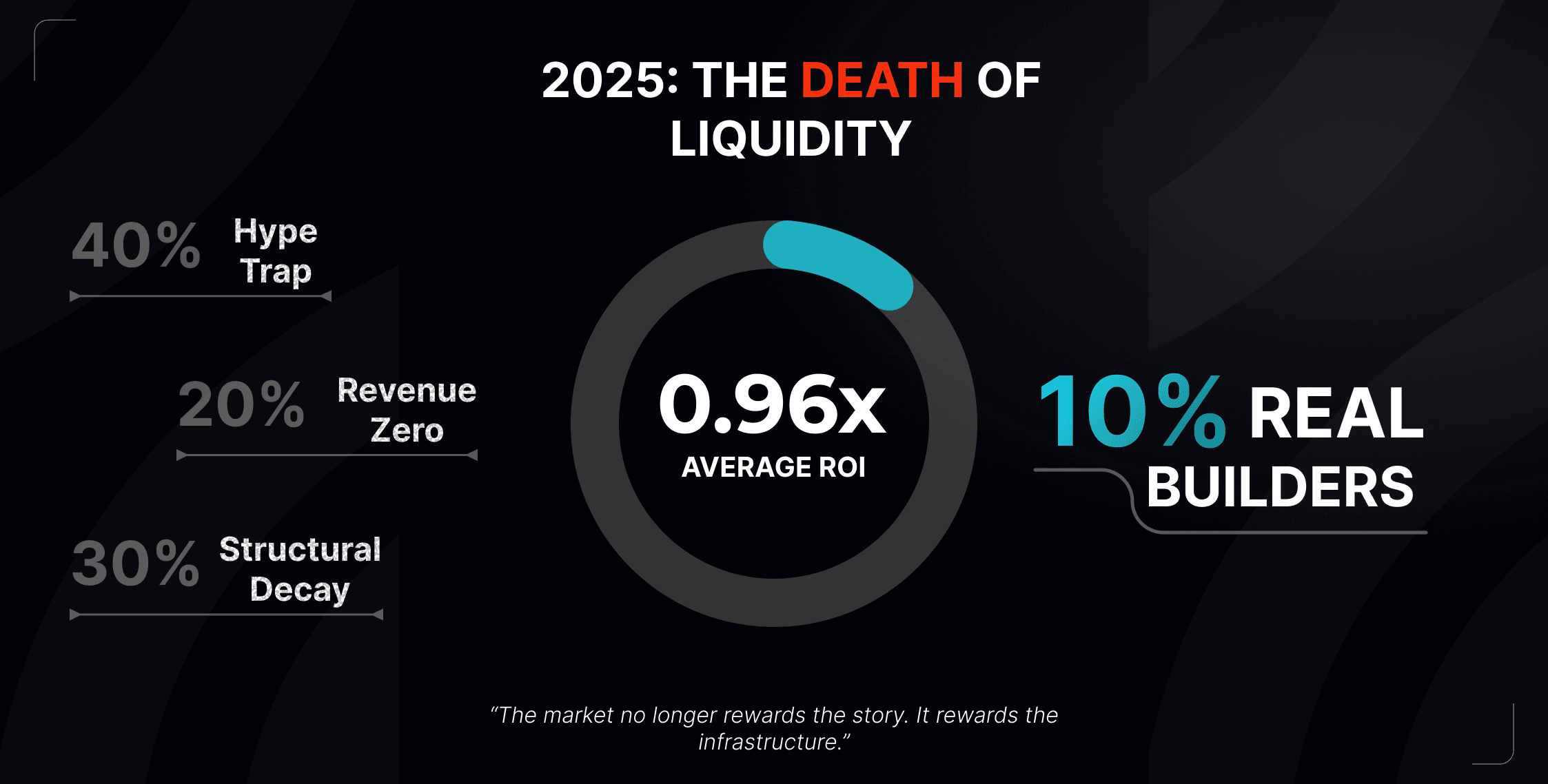
According to data pulled from Solus Partners and ICO Analytics, the average token launch ROI in 2025 was 0.96x. Curiously, not from ATH or after unlocks. From Day 1.
That single number killed more projects than any regulation ever could.
Web3 used to sell a simple promise:
Take risk → get asymmetric upside.
And in 2025, founders took the risk. The upside never showed up.
Launching at a loss destroys everything downstream:
No secondary demand
No leverage in partnerships
No talent retention
No morale
Founders were told they were “early,” that price discovery would come later, and that short-term pain was the cost of long-term upside. In 2025, that narrative collapsed.
Launching underwater doesn’t destroy leverage. It removes your ability to hire, weakens your position with partners, and turns every future funding conversation into damage control. What used to be framed as being “early” is now simply capital inefficiency.
Loud headlines won’t tell you this.
Yes, deal count collapsed by ~49% YoY. But the money, as many thought, didn’t vanish. It pooled.
Capital concentrated around a small circle of institutions:
Coinbase ecosystem
Pantera-level funds
A handful of TradFi-comfortable allocators
Structured investor communities with aligned long-term logic now matter more than raw visibility.
What about early-stage builders, then? Starving in a room full of food they can’t reach.
This is why Web3 fundraising in 2026 will reward structure.
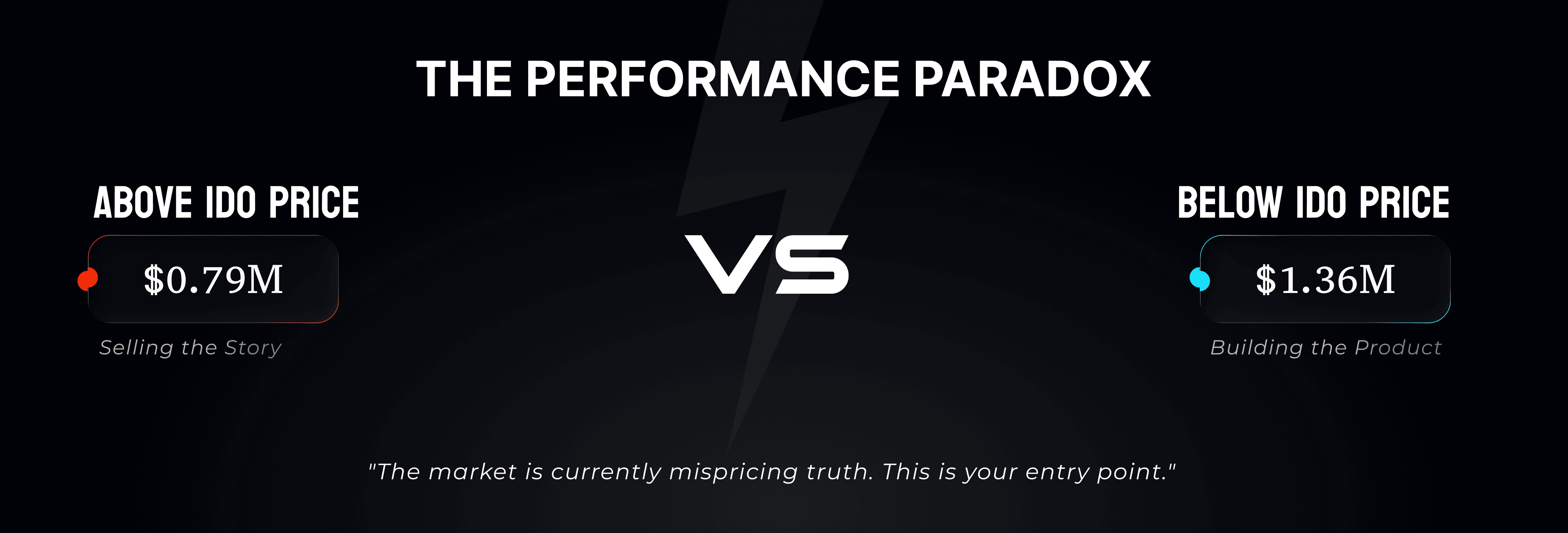
Now, let's take a look at the uncomfortable stat.
Projects trading below IDO price generated $1.36M average revenue. Projects above IDO price? $0.79M.
Read that again.

That’s not bullish, though. That’s broken price discovery.

If 2025 exposed the cracks, 2026 will collapse anything built on denial.
The smartest people are not leaving Web3 because they stopped believing.
They’re leaving because:
Compensation collapsed
Tokens stopped working as incentives
Founders burned out in isolation
Token-based compensation stopped working. Runway uncertainty increased.
AI and Big Tech, however, didn’t “steal” talent; they offered stability, tooling, and functional incentives.
Until Web3 fixes how it supports builders as humans, not just as wallets, the drain will continue.
The era of deck-only raises is over.
In 2026, investors expect:
Clear revenue mechanics
Defined buyers, not hypothetical users
Legal and financial structures that won’t implode under diligence
A credible path to liquidity
Talk to us

Solus didn’t pivot (though you might have expected that).
What we’re building now is infrastructure for a harsher market reality.
The last time we branded ourselves, Solus was ten people in a garage-style office. It was @1inch, @wavesprotocol, and a handful of one-day projects. Zero sleep, no office cat, and a whole lot of hustle.
Today, we still have that same vibe - but backed by 70 of the best people in the industry. From clients like @Aster_DEX to moving alongside giants like @OndoFinance, we are everywhere you want to be.
Web3, at the current moment, suffers from an inability to absorb institutional money.
Through Solus Partners, we operate at that intersection:
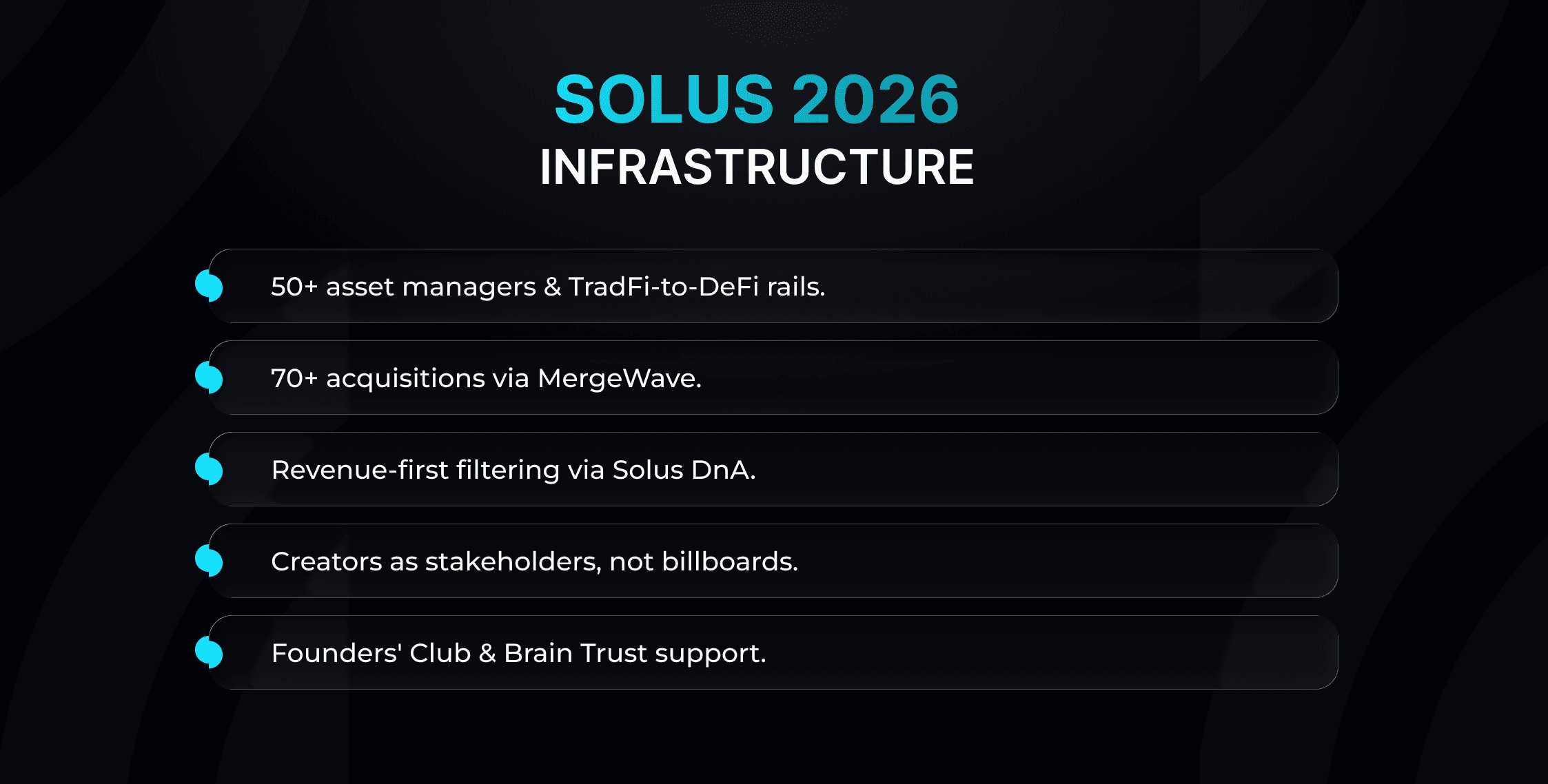
50+ asset managers, hedge funds, and family offices as close LP partners
Strategic partnership with Kinetik ($3B AUM)
Partnership with Hilbert Group ($500M AUM), focused on TradFi-to-DeFi via Syntetika
This is how Web3 becomes investable again, and essentially more disciplined.
While we prepare for 2026, the immediate tactical shifts of next year cannot be ignored. Explore the top Web3 marketing trends to watch in 2025 to stay ahead of the curve.
Only 16% of Web3 projects report revenue data.
That’s clearly just avoidance.
Through SolusDnA and Solus Partners, we run on a simple rule: if the numbers don’t hold up, the story doesn’t matter. We don’t chase hype cycles, but filter them.
In a market saturated with narratives, truth becomes the scarcest asset and the strongest signal.
With deal flow collapsing, consolidation becomes the default growth strategy.
Through MergeWave Capital, Solus has already closed 70+ full or partial acquisitions in Web2 tech and is now extending that M&A infrastructure into Web3.
Acquisition means many things: liquidity, focus, and survival.
The traditional KOL model collapsed under its own weight.
Solus Agency is pushing a different approach: B2B influence.
Creators as stakeholders, not billboards
Transparent performance via Web3 Brokoli, powered by Cookie3 and Solus infrastructure
Signal over reach, credibility over impressions
Marketing in 2026 is all about being believable.
The biggest threat to Web3 right now isn’t regulation.
It’s… isolation.
That’s why Solus is building real human infrastructure:
A Founders’ Club (launching soon)
Operator-to-operator support
A Brain Trust Advisory Board
Technology scales fast, but humans don’t. And that's normal, but it doesn't have to be like that; we’re fixing that gap.
This is the Web3 2026 playbook stripped of theory.
Verifiable revenue or a credible monetization path
Clean cap table and legal structure
A narrative grounded in data
Clear logic for how liquidity enters and exits
If it can’t survive diligence, it won’t survive 2026.
Distribution partners identified early
Trust signals that go beyond vanity metrics
Buyers defined before launch, not after
M&A pathways mapped from the start
Strategic acquirers identified early
Optionality built into the company structure
Web3, obviously, isn’t dying. But at this point, it’s shedding weak infrastructure.
Solus Group was born in the 2017 trenches and matured in the boardroom. We’ve seen chaos, survived it, and built systems for what comes next.
We’re narrowing focus, selecting a small group of founders for full-scale acceleration right now.
If you’re still running a 2021 playbook, 2026 will break you.But you’re ready to build with liquidity, truth, and real exit logic — we’re already here.
Token launch ROI in 2025 averaged 0.96x. Most projects were underwater, not after the crash, but from Day 1.
Deals fell ~49% YoY.
Hype is outperforming performance, and that’s breaking real builders.
Old Web3 playbooks (2017 / 2021) are actively dangerous in 2026.
Web3’s next phase is infrastructure-led: liquidity, M&A, real revenue, and real people.
Schedule a call
Because secondary market demand disappeared.
Most tokens launched without real liquidity planning, real buyers, or revenue-backed valuation logic. When supply unlocked and no structured demand existed, price immediately fell below entry.
No. It’s a bad time to launch without infrastructure.
In 2026, successful launches will require:
Defined liquidity pathways
Institutional alignment
Clear monetization logic
Structured exit optionality
The market is harsher, but also way more rational.
Because narrative still temporarily outperforms fundamentals.
But 2026 will punish that disconnect. Without real revenue or liquidity design, narrative premiums collapse under unlock pressure.