
20 Min Read

Vlad Zghurskyi
Content Creator
Ambassador vs KOLs programs: Choose the right strategy! Understand when to use a brand ambassador, influencer marketing, KOL, or key opinion leader.
20 Min Read
Vlad Zghurskyi
Content Creator
Ambassador vs KOLs programs: Choose the right strategy! Understand when to use a brand ambassador, influencer marketing, KOL, or key opinion leader.
You can buy attention all day long. Charts, threads, impressions, likes - yep, none of that is hard. What’s hard is turning that attention into users who are onboard, understand what you’re building, and stay after the hype cycle collapses.
That’s why the conversation around ambassadors and KOLs is usually broken from the start. Most teams lump them together under “influencer marketing” and then wonder why their campaigns don't work.
So let's figure out the difference once and for good. Keep reading!
Ambassador ≠ Influencer by Default
In Web3, an ambassador is often defined by the program they join, not their existing reach. The title follows the structure, not the influence.
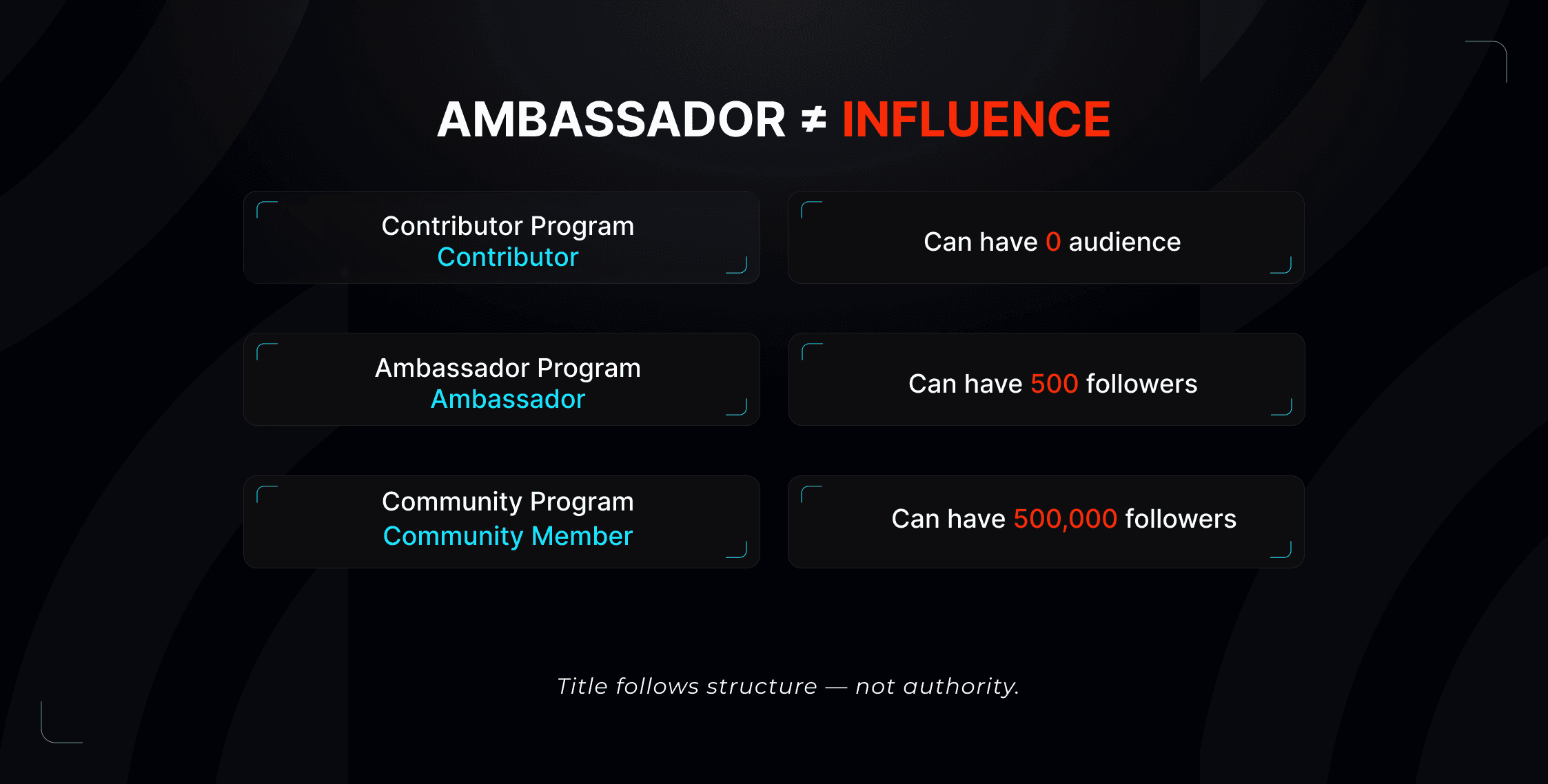
Before comparing strategies, it’s important to be precise with terms. A lot of wasted budget comes from using the same word to describe very different relationships.
A KOL (Key Opinion Leader) is defined by audience + authority, not by participation in a program.
A KOL is someone whose opinion already matters inside a specific niche — crypto, DeFi, gaming, research, trading, culture, or a micro-community most people don’t even know exists.
They may be:
Loud YouTubers
Anonymous Twitter accounts
Respected builders
Researchers
Founders
Or operators with small but highly trusted Telegram groups
The defining trait is simple: People listen to them without you asking.
Because of that, KOLs can:
Shape perception
Legitimize narratives
Explain complexity
And transfer trust
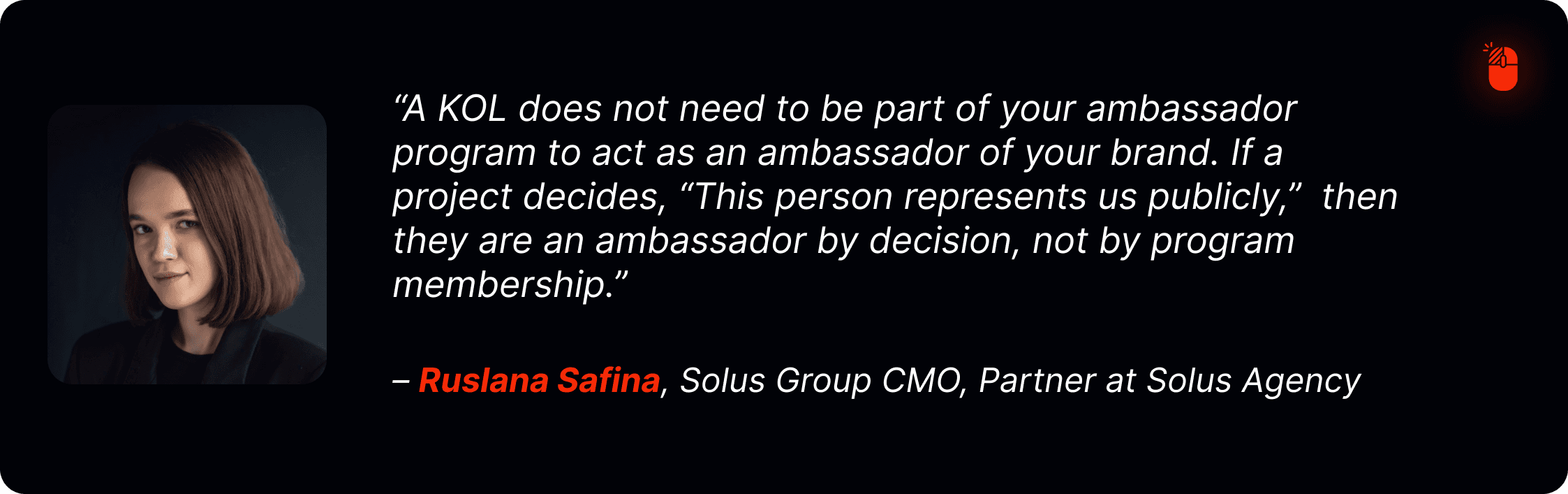
An ambassador is anyone performing an ambassadorial role for the project.
In Web3, ambassadors usually exist because the project runs an ambassador program which is a structured system for contribution.
Inside that program, ambassadors can:
Manage social media accounts
Moderate Discord or Telegram
Onboard users
Write guides
Organize meetups
Translate content
Support users
or yes — even “carry stones” if that’s what the project needs.
Their value comes from what they do, not who watches them.
That’s why someone with no personal brand can be a perfect ambassador, and someone with a massive audience can be a terrible one.
Ambassadorship is functional, but it does not have to be reputational.

Before comparing strategies, let’s be precise. A lot of budget is wasted because teams use the same word to describe very different relationships.
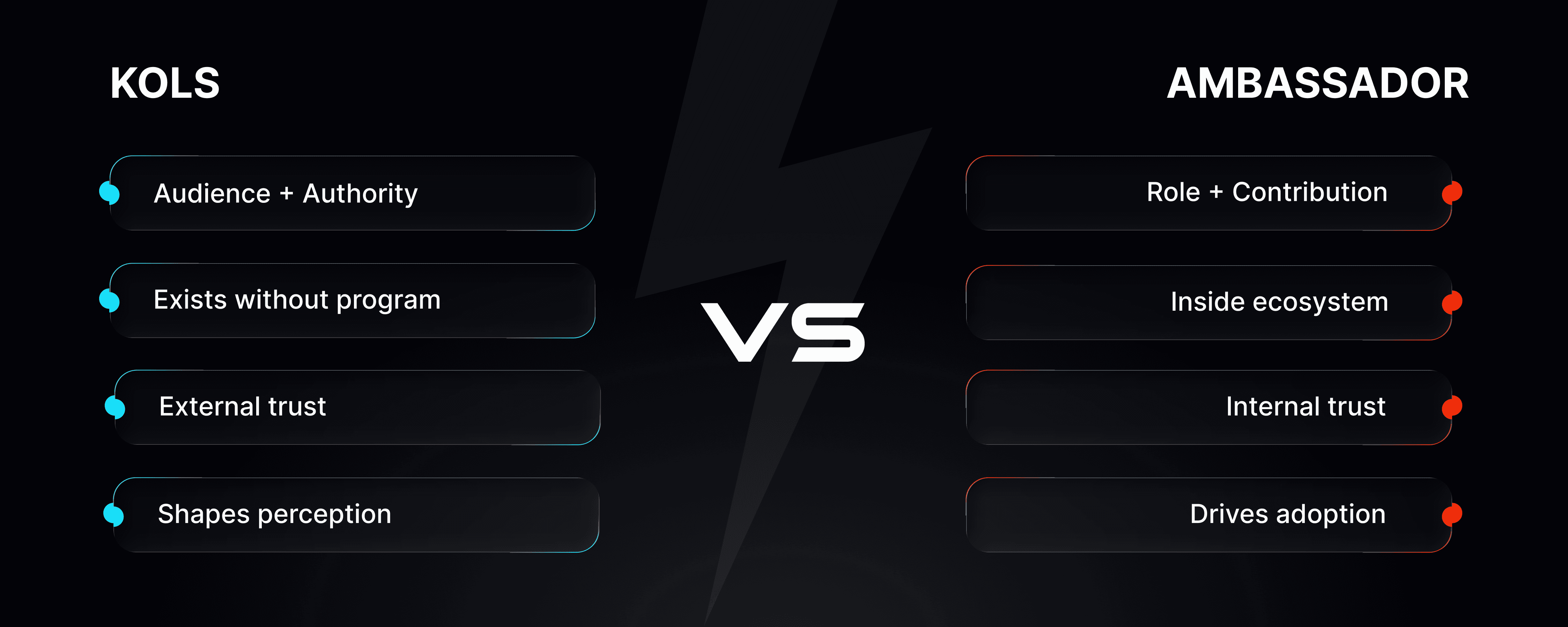
KOLs are primarily about brand awareness and narrative authority. Of course, there could be more goals than just that - KOLs are versatile and can act as users for your projects or investors. And
Yet, mainly, they help define how your project is perceived by people who are not part of your ecosystem.
Ambassadors are about adoption, retention, and brand behavior.
As we love saying it, on Web3 trust comes from others - from people who talk about you, not from you.
Ambassador programs scale that trust by turning community members into advocates who educate, onboard, and make your message more loud.
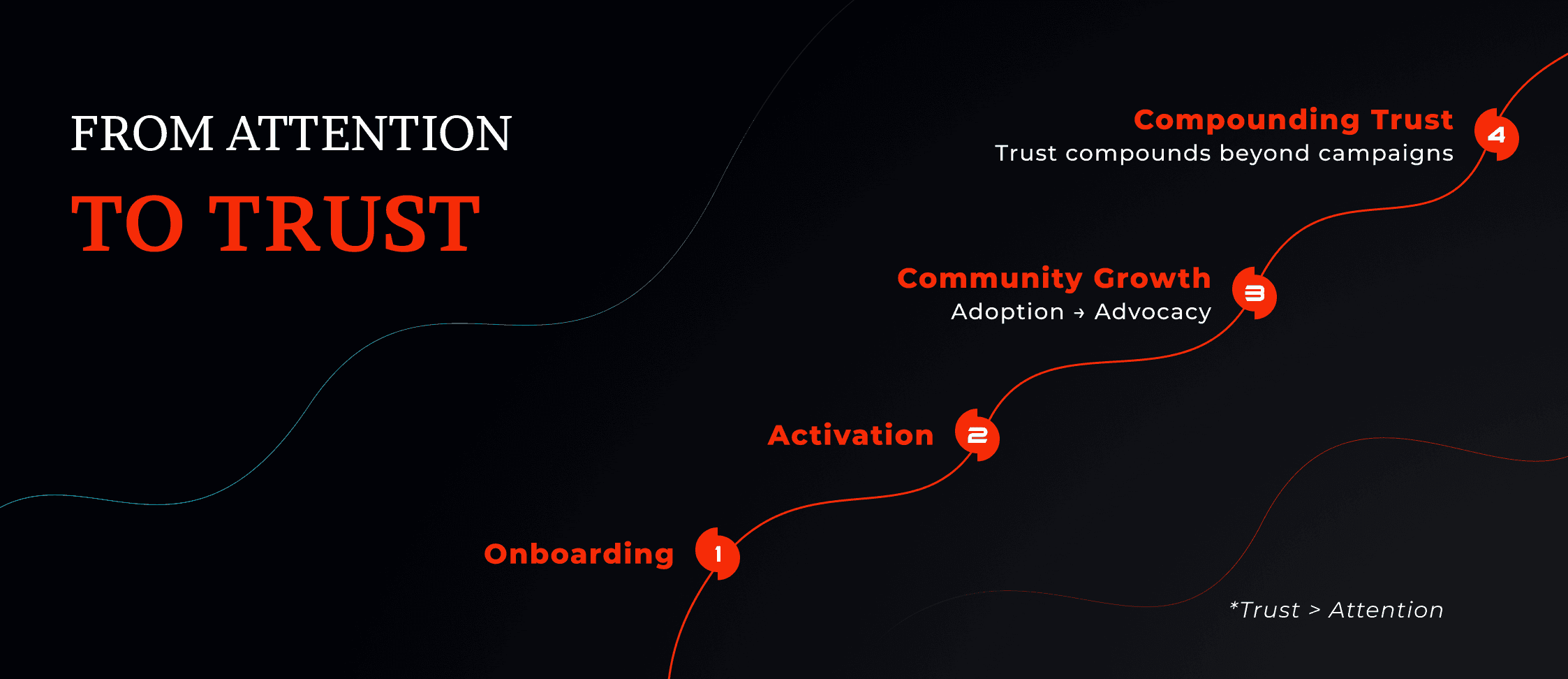
KOL campaigns move fast, generating immediate spikes. Ambassador programs move slowly at first but compound over time. Here is how the trust trajectory looks:
Start execution

With KOLs, the audience belongs to the KOL. Your brand gets temporary access to that.
With ambassadors, the audience overlaps with your own community. Ambassadors operate inside your Discord, Telegram, Twitter, Reddit, or local meetups. They sort of absorb traffic.
Effective KOLs protect their independence. That’s why they are trusted.
When you work with KOLs, you influence direction, not wording. Trying to control every sentence usually backfires.
Ambassadors are different. They are trained, aligned, and continuously educated. Over time, their ability to incorporate your brand into their digital conversations improves because they understand nuance, not just talking points.
KOL content is campaign-driven. Threads, videos, podcasts, product testing, event mentions, long-form explanations.
Ambassador content is operational. Replies, guides, onboarding help, UGC, moderation, community activation, daily presence.
Both are valuable, but they serve different stages of growth.
Just in case, we can help you orchestrate and produce both. For example, as Storm Trade prepared for its TGE, the platform needed to scale its visibility, engage its target audience, and build a community that would champion the brand.
We attracted and retained high-quality influencers and advocates, while fostering consistent engagement and driving impactful content creation.
Drop us a message if your project requires the same balance between short-term campaigns and long-term community work.
KOL risk is external. One poorly aligned endorsement can damage credibility quickly and publicly.
Ambassador risk is internal. Weak management, unclear incentives, or inconsistent rewards can quietly ruin relationships with your ambassadors. And once trust is broken, programs collapse.
This is why the effort required to work with KOLs is higher per campaign, while ambassador programs demand ongoing operational discipline.
Longevity is not determined by the label, but by how the relationship is structured.
KOL relationships can be episodic or long-term. Some revolve around a specific launch, narrative, or moment in time. Others evolve into sustained partnerships where a KOL repeatedly engages with the product, discusses it organically, and becomes a recognizable long-term supporter.
What matters is not duration, but continued alignment and independence. As long as a KOL’s interest remains genuine and their voice stays autonomous, the relationship can persist without losing credibility.
Ambassadors, on the other hand, are designed for continuity by default. Their involvement is tied to participation in the ecosystem. They don’t “show up for a campaign” and leave; they operate inside the project. As long as the ecosystem grows and incentives remain fair, ambassador activity compounds naturally over time.
The key difference is not whether one can be long-term and the other cannot, but where longevity comes from.
KOL longevity comes from sustained belief and relevance.
Ambassador longevity comes from ongoing contribution and structure.
Both models can last; they just last for different reasons.
Another difference doesn’t get talked about enough: organizational gravity.
A small team of KOLs can generate attention quickly, but it rarely creates internal structure.
Ambassadors, on the other hand, become part of your operating layer. Over time, you’re no longer dealing with isolated influencers, but with a coordinated network of social media influencers who understand your product, your tone, and your goals. Among your team of influencers, roles emerge naturally: educators, community leaders, regional voices, and content creators.
Choosing between ambassadors and KOLs is all about fit. We already established that goals matter, and based on them, you should be moving to KOLs or ambassadors. But there is more to it.
Your timeline to first impact matters. KOLs deliver faster. Ambassadors take time but don’t decay the same way.
Your budget profile matters too. Partnering with KOLs can sometimes require a higher price for your brand upfront, while ambassador programs spread the cost across time, performance, and contribution.
This is one reason many teams mix ambassador programs with affiliate marketing models once the brand is using performance-based incentives.
Control over the message is another key factor. Ambassadors already love your brand, which makes alignment easier. With KOLs, control is intentionally looser because credibility depends on it.
Ambassadors are the right choice when your brand has moved past “just launching” and into “actually operating.”
They work best when:
You’ve built up brand love amongst early users
Your product needs education, not just exposure
Community trust drives adoption
You want a team of influencers that can generate consistent, compounding results
Ambassadors love your brand, and that matters more than reach. The strength of working with ambassadors is their persistence.
KOLs are the right choice when credibility and visibility matter more than continuity.
They’re especially effective for:
Token or TGE narratives (without price promises)
Major version launches
Partnerships and integrations
Cross-chain expansions
Entering new geographic or cultural markets
KOLs can help you reach audiences in ways that are ambassadors, especially when those audiences are less interested in your brand initially and more interested in who is speaking.
That said, partnering with KOLs can sometimes look forced if the alignment isn’t real. Many KOLs are famous authors or respected operators, and their audience will immediately sense when a brand doesn’t fit their worldview.
The most mature setups don’t choose between ambassadors and KOLs. They design how the two interact. And that's what we do in Solus.
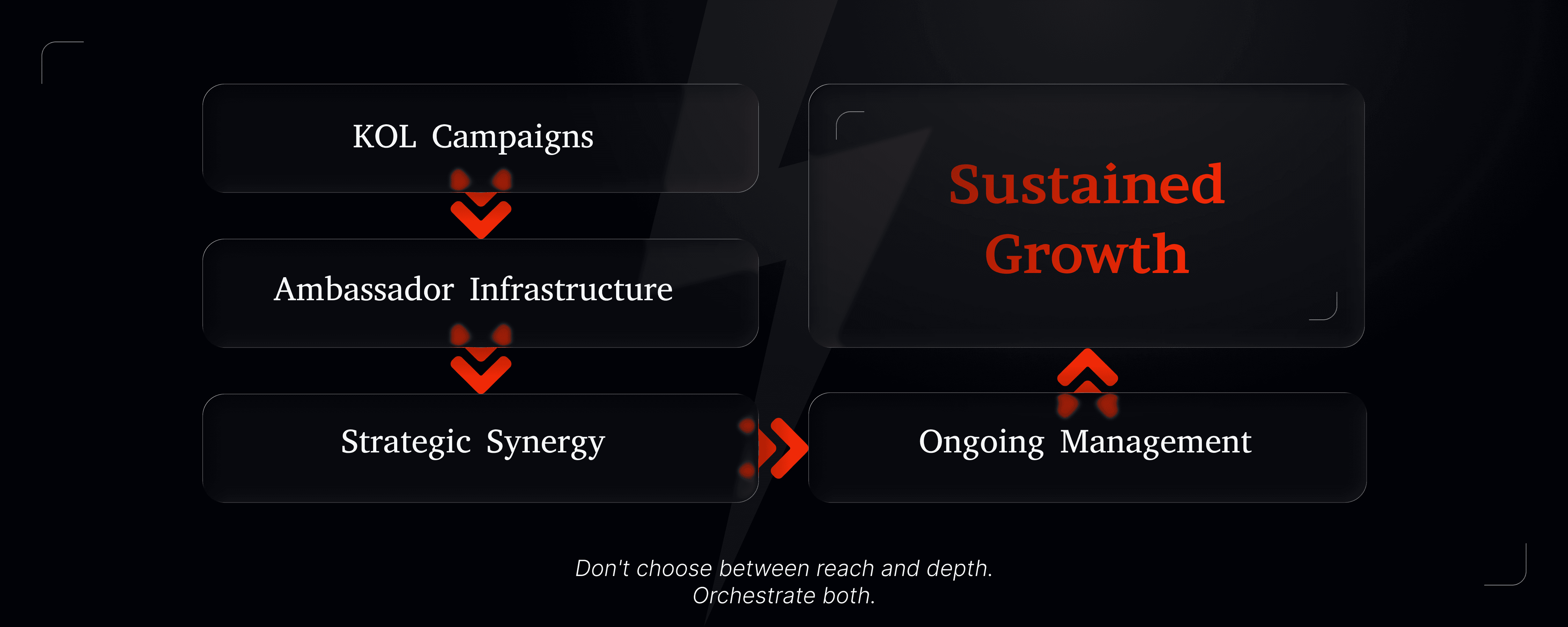
The thing is, if you don't know what will suit your project, just let us do that lifting. We can choose the best option, design and run it. And you’ll watch the results stack!
Whether you choose an ambassador or a KOL, the execution must be flawless to go viral. Dive into the anatomy of a viral Web3 KOL campaign to see how it's done.
Most teams fail because they misunderstand the relationship.
They treat ambassadors like paid promoters instead of long-term partners.
They treat KOLs like media buyers instead of independent voices.
They confuse reach with influence.
Influencers can help, but only when the strategy aligns with the role. Using social media influencers might achieve visibility, but without structure, results remain shallow. Media influencers might achieve better short-term numbers, but ambassadors shape behavior over time.
If your influencers are less interested in your brand than in the next campaign, it won't work long-term.
KOLs and ambassadors play fundamentally different roles in growth, and problems start when brands expect them to behave the same way.
Longevity doesn’t come from choosing the “right” label. It comes from how the relationship is structured.
Ambassadors are built for long-term involvement by default, while KOLs only become long-term partners when alignment, trust, and shared context are deliberately developed
The strongest influence strategies don’t rely on a single model. They use KOLs to create momentum and ambassadors to absorb, translate, and sustain that momentum over time.
Let’s talk
The difference is how trust is built. A KOL influences through perceived expertise and authority in a specific niche. An ambassador influences through long-term belief and emotional alignment with the brand.
KOLs are the better choice when you need to move perception quickly. This includes launching a new product, entering a new market, explaining something complex, or borrowing credibility you haven’t earned yet. They help people understand why something matters before they’ve had time to develop brand attachment.
Ambassadors work best when your focus is long-term brand equity, community depth, and consistent presence. If you’ve already built up brand love — or want to — ambassadors reinforce that belief over time. They’re ideal when trust matters more than reach and when repeated exposure is more valuable than short-term spikes.
Yes, and the strongest strategies often do. KOLs can open doors, validate ideas, and frame the narrative, while ambassadors carry that narrative forward over months or years. The key is not treating them as interchangeable. Each role needs a different structure, expectation, and success metric.