
15 Min Read

Vlad Zghurskyi
Content Creator
Web3 is a credibility economy. Anyone can tweet a cool screenshot of a token and get a few thousand likes. But… likes don’t build long-term users, on-chain activity, or real product adoption.
15 Min Read
Vlad Zghurskyi
Content Creator
Web3 is a credibility economy. Anyone can tweet a cool screenshot of a token and get a few thousand likes. But… likes don’t build long-term users, on-chain activity, or real product adoption.
For crypto brands and Web3 startups, the harder job is converting attention into trust and utility.
And that’s why KOL campaigns matter: they do better than get your name in people’s feeds. They move the right people - developers, contributors, traders, DAOs - to act.
But if you want to understand what actually makes a Web3 KOL campaign go viral, you first need to understand the people driving it. Not all “influence” works the same way in this space, and not every voice can spark the kind of trust Web3 requires. Keep reading!
Let’s clear this up first.
Many KOLs simply have deep expertise in something. Maybe they used to build, trade, or research, and now they share that knowledge online. They might not be running a company anymore, but their opinions still shape how others think.
So what’s the nuance?
In practice, the line between a KOL and an influencer is often blurry, and especially so in Web3. Theoretically, they mean the same thing. But over time, the term “KOL” started to get a bad rep.
Why? Because too many fake accounts began calling themselves KOLs while boosting engagement numbers with bots or recycled content. You know the type: an anonymous “crypto girl” account that’s actually run by a middle-aged guy farming likes with AI-generated photos.
That’s why the word “KOL” sometimes sounds sketchy now.
Another funny part: when you say “KOL” to people outside of Web3, they often have no clue what you’re talking about. But… it’s basically just a Web3-flavored version of “influencer,” used inside the community to mark who holds sway in the space.
Bottom line: at the end of the day, it’s the same idea. Someone whose opinion moves people.
Not every KOL is loud or public, though. Many shape opinions quietly, within niche circles, communities, or private chats.

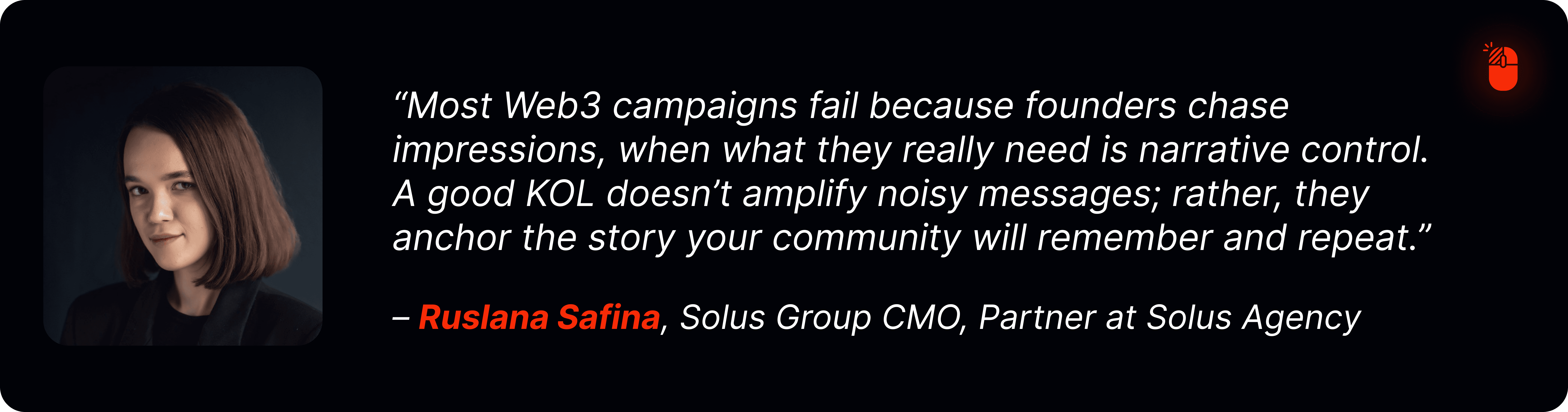
When you design a KOL marketing campaign for the Web3 ecosystem, obviously, you have to be picky:)
The type of KOL you choose defines how your brand connects with the Web3 community, what kind of marketing tactics you deploy, and ultimately, whether your crypto campaign gains traction.
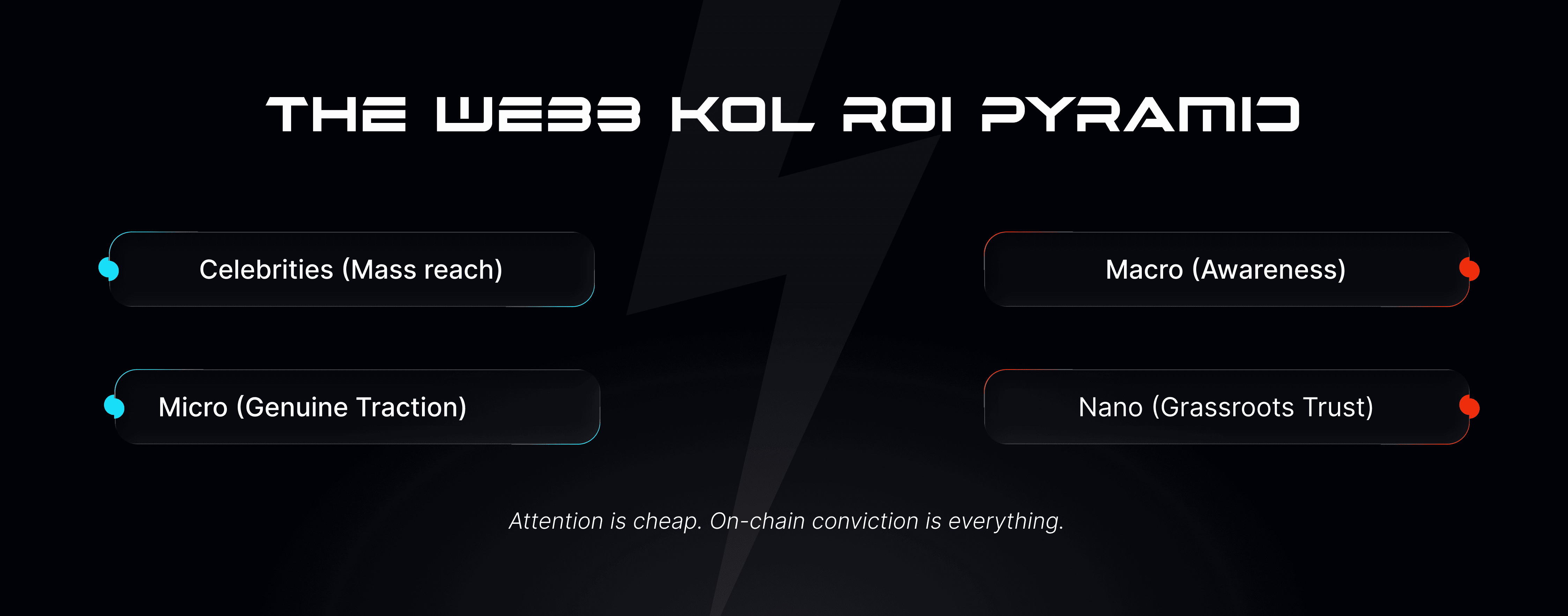
Below are the main categories of KOLs you’ll encounter when planning to launch campaigns in the blockchain space.
Celebrities have long been the cornerstone of influencer marketing. In Web3, they can drive massive attention to crypto projects almost overnight. Think of global stars who endorse NFTs, or athletes launching tokens. Their reach is unmatched, but so are the risks.
Celebrity-driven hype might lead to a short-term spike without lasting engagement in the Web3 community. However, the chances that you’ll partner with them are rather minor - they are highly unreachable.
Remember that a successful influencer - and more importantly, the one who can build impactful influencer marketing campaigns - doesn't necessarily have millions of followers.
Macro influencers sit between celebrities and micro. They have sizable audiences (hundreds of thousands to millions) and often dominate marketing in the crypto space through YouTube channels, podcasts, or crypto news platforms. Unlike celebrities, they are more native to the Web3 ecosystem and are able to balance scale with relatability.
Your best ROI usually hides here. With 5K–20K followers, these are the active DAO contributors, local community leads, or niche Telegram mods who actually talk to their audiences. Their engagement rates are high, and their audiences trust them. They might not blow up your metrics overnight, but they can spark genuine traction.
Don’t underestimate them. With 1K–5K followers, nanos sit right at the grassroots level, often building micro-communities, early Discord groups, or regional hubs. Their audiences are small but real, and that authenticity translates into credibility that money can’t buy.
Choosing the right Web3 kol is about making = sign between your influencer marketing process with the realities of the Web3 ecosystem, the expectations of your crypto community, and the market trends shaping the future of Web3. That’s a lot of equals. But believe us, it’s absolutely worth it.
A poorly managed partnership can burn through budget with little ROI, while the right match can take your campaign management to the next level.
But… if you want to see and apply all the draining thinking that goes into analyzing influencers, we’ve got a bit of a Bible reading for you (only volume-wise, of course).
The first step is ensuring that the KOL’s followers are the right people for your crypto project. Many influencers have broad audiences, but if those audiences don’t overlap with your country-specific crypto communities or your investor profile, the campaign management effort may flop. This is why effective influencer outreach should start with audience analysis rather than follower count.
Look at demographics: region, age, preferred platforms.
Verify their interest in blockchain and crypto beyond surface-level engagement.
Cross-check their audience overlap with your target marketing channels.
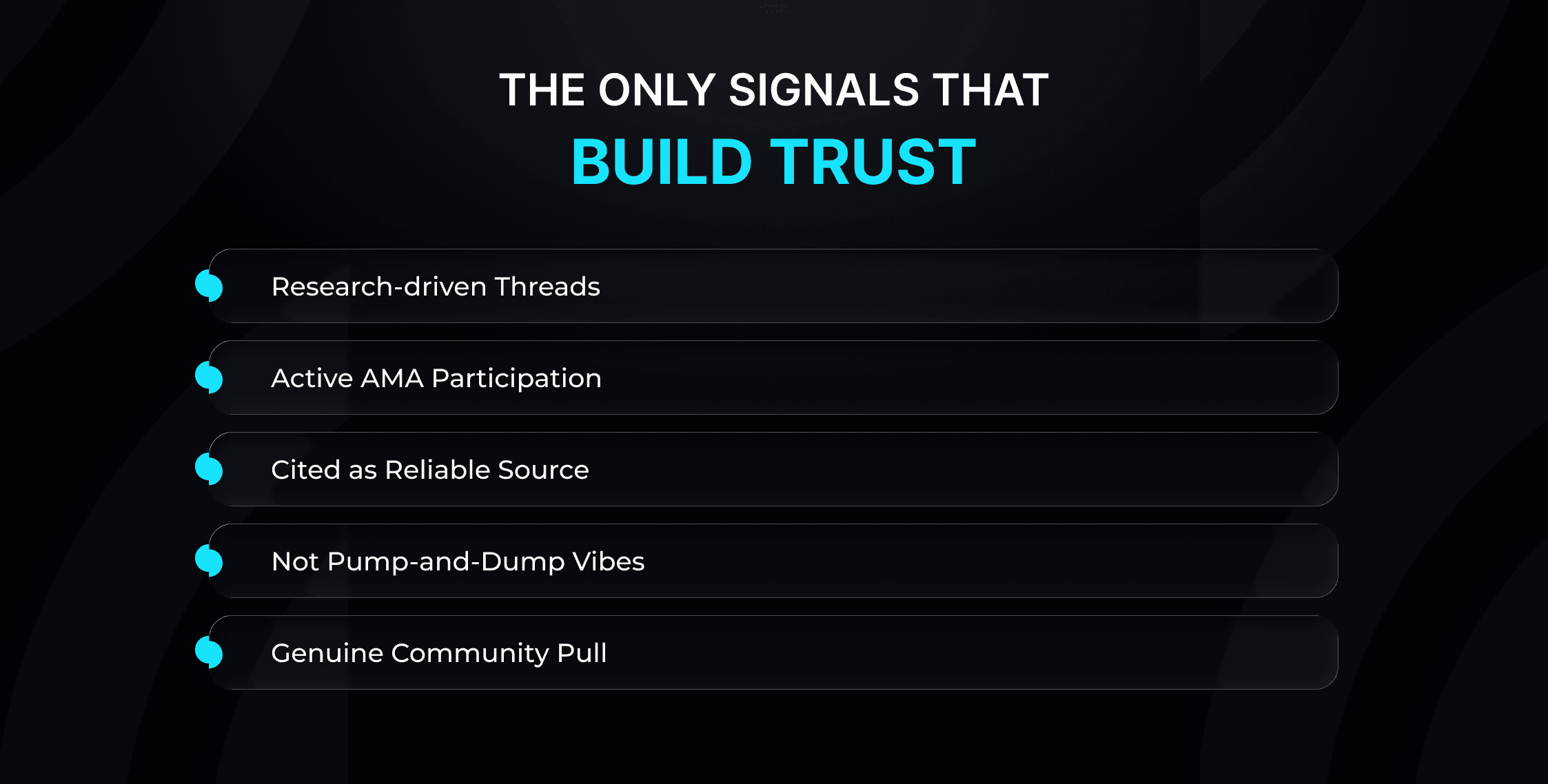
A KOL who is respected by influencers in the crypto space brings validation to your project. Unlike traditional marketing methods, crypto influencer marketing involves technical and financial trust. You want KOLs who publish research threads, participate in AMAs, and are cited as reliable sources.
A credible KOL ensures your brand message doesn’t look like a pump-and-dump move but a serious player in the future of Web3.
Web3 is global, but adoption is local. Each country has unique crypto influencer marketing leverage: in Vietnam, Telegram and Facebook groups dominate; in the U.S., it’s Twitter/X a/X nd YouTube; in LATAM, community-driven WhatsApp groups drive traction.
Marketing agencies in 2025 predict that hyper-local KOL targeting will outperform blanket global strategies, especially as regulations differ region by region.
Web3 KOL marketing involves trust that compounds over time. Building long-term relationships with KOLs ensures they integrate your project into ongoing content marketing efforts. This positions your project as part of their personal journey with the community.
Not every KOL is right for every brand.
If your project is about sustainability, a KOL known for hyping memecoins isn’t the right fit. The right KOL shares your vision and reinforces your brand goals.
This alignment is how modern marketing evolves in the Web3 space. And if you want to make sure your brand has it, you might want to have on-point influencer recommendations. In that case, you can always hit us and we'll solidify the success of your crypto campaign.
Even the best selection framework won't save a campaign if you fall for common industry traps. To protect your budget, read more about the most frequent influencer marketing mistakes here.
Audit your campaign

The marketing industry is shifting fast, and nowhere is that more evident than inside Web3 marketing. Traditional ads can’t cut through decentralized communities. But KOL campaigns can.
That's why many projects now turn to Web3 marketing agencies and specialized Web3 marketing services to design strategies that feel authentic. Done right, a KOL campaign becomes the engine that powers lasting growth in the Web3 space.
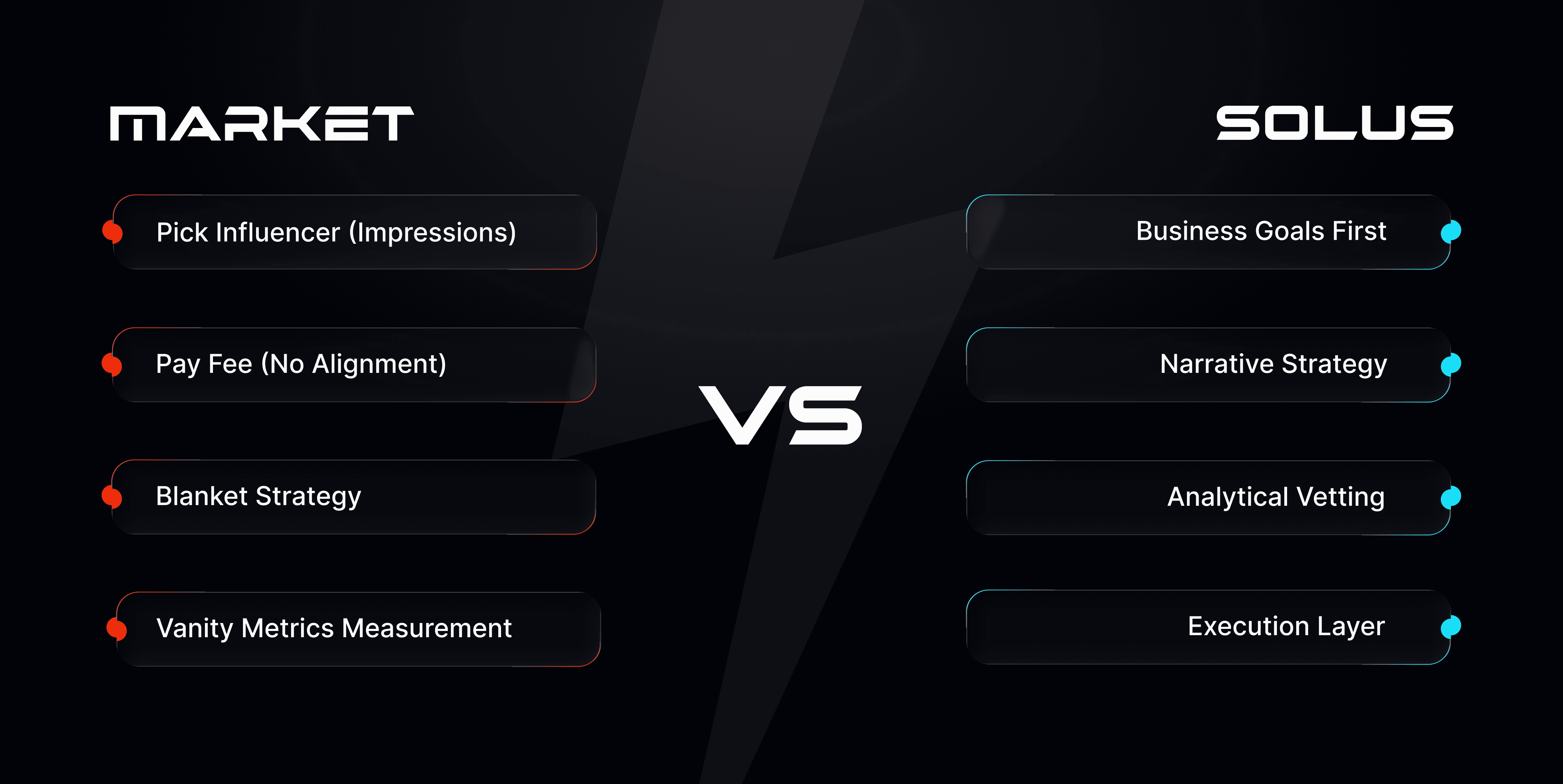
But…let’s talk about that in two parts. How it is usually done, and how we do it.
So, this is a traditional approach:
Every effective strategy starts with clarity. Before you even think about outreach or budgets, define what success actually means for your project. In the world of Web3, vague intentions like “get more followers” rarely bring you successful campaigns. Tie your objectives to the growth stage of your web3 projects.
For web3 brands, clear goal-setting takes marketing to the next level. For example, instead of chasing empty impressions, set KPIs around wallet sign-ups, engagement within Discord, or NFT minting activity.
The role of crypto KOLs here is to act as amplifiers. Their voices can build credibility, signal legitimacy, and move communities to action. When structured well, influencer endorsements create momentum around your narrative, ensuring your goals are not just set but actually reached.
Not every influencer fits every blockchain project. The right influencer has credibility with your target audience, whether that’s DeFi traders, NFT collectors, or DAOs. Use a mix of micro and macro KOLs, ensuring they cover both grassroots engagement and wider reach.
In Web3, budgets are often split across phases: pre-launch, launch, and post-launch amplification. Decide early how much you’ll allocate to crypto marketing influencer strategies, so you don’t burn funds too quickly. Factor in content creation, platform promotion, and agency fees if you’re working with a crypto marketing agency.
KOLs need something to share. Provide high-quality cryptocurrency digital marketing materials: explainer threads, visuals, infographics, demo videos, or even interactive dApp walkthroughs. The more compelling the content, the easier it is for influencers to amplify your message.
One of the most overlooked steps in web3 influencer marketing is systematic measurement. Without clear tracking, you’ll never know if your campaign actually worked or just looked good on paper. The first thing to do is define your metric framework: impressions, engagement, conversions, and, in the case of token launches, actual wallet activity.
Use tools that integrate directly with social media platforms to capture campaign data in real time. This way, you’re not just relying on vanity numbers but evaluating how influencers in web3 actually impact your community’s growth.
Results are only valuable if they guide iteration. Once you’ve collected campaign data, analyze what worked and what fell flat. Maybe your micro-KOLs drove higher retention while a top web3 YouTuber brought in fast but low-quality traffic. That’s where the power of influencer marketing comes in — understanding that influence is relevance.
Refinement means adjusting budgets, reallocating partnerships, and creating better content assets for the next cycle. Over time, this process transforms your approach from one-off experiments into repeatable influencer marketing strategies that compound results.
So…
Most agencies follow a pretty basic playbook. They start by defining goals, then pick influencers to match those goals. Or worse, they just pick influencers first and set goals later. And that’s where most campaigns stop.
Web3 influencer marketing often feels like a supermarket: a project walks in, grabs a few “influencers” off the shelf, pays the fee, and hopes for the best.
Our flow is different.
We always begin by understanding the project's business goals.
Like what it’s ACTUALLY trying to achieve beyond surface metrics. Only then do we develop the influencer marketing strategy and its context, which includes the story, positioning, and message.
After that, we reach out to influencers we’ve identified as analytically relevant.
Meaning: they have real alignment with the project’s values and genuine interest in what it’s doing.
And yes, that stage can be long, detailed, and sometimes painfully slow. But it’s also the part that separates real partnerships from random shoutouts.
Only after this careful stage of communication do we move toward execution.
KOL marketing is about renting trust. Attention fades fast; credibility compounds.
Stop treating influencer marketing like a supermarket. You don’t “pick” KOLs, but you build alignment with people whose opinions actually move your community.
Data matters, but context wins. Engagement rates mean nothing if your influencer’s audience doesn’t care about your chain, your token, or your mission.
Micro beats macro more often than anyone admits. Big numbers look nice on pitch decks, but small, trusted voices are what move on-chain activity.
The best KOL campaigns are collaborations, and not ads. If your influencer sounds like a commercial, you’ve already lost.
Don’t confuse noise for traction. Virality is great, until you realize half your engagement came from airdrop farmers and bot armies.
Long-term KOL relationships > one-time shoutouts. Sustainable trust beats temporary visibility, every single time.
Your KOL strategy is only as good as your patience. Real partnerships take time, but they deliver results that algorithms can’t fake.
Schedule a call
Yes. Just like in traditional industries, influencers in web3 come in different tiers — from niche developers with small but loyal communities to top web3 celebrities who dominate global headlines. Each plays a unique role depending on your goals.
Start by clarifying your objectives. Is it brand awareness, community trust, or user adoption? Then match those goals with the right profiles. For example, educators are great for technical depth, while entertainers shine on social media platforms. A mix usually delivers the best balance.
Look at credibility, relevance, and how their content style aligns with your project. Many teams rely on influencer campaign marketing services to handle vetting, contracts, and data tracking, but even without an agency, you can succeed if you focus on fit and authenticity.