
15 Min Read

Vlad Zghurskyi
Content Creator
If you’ve ever tried to explain Web3 marketing 101 to someone who only knows Google Ads, you know the look they give you. Half confusion, half panic.
15 Min Read
Vlad Zghurskyi
Content Creator
If you’ve ever tried to explain Web3 marketing 101 to someone who only knows Google Ads, you know the look they give you. Half confusion, half panic.
Well, it is easy to understand that.
Traditional dashboards don’t tell you much when half your audience lives on-chain and your “conversion funnel” starts with a crypto wallet.
That’s why measuring Web3 through page views or click-throughs won’t work. You need to understand how real users move through your ecosystem: what wallets interact, who actually mints, swaps, or joins your DAO. You have to leverage Web3 marketing data differently because the metrics are baked into the blockchain itself.
But…have exactly should you do that?
Let's explore how to measure your Web3 growth and the success of your Web3 marketing campaigns.
Just to clarify: when talking about Web3, we mean the space where real, true on-chain exists. Now, let’s talk the metrics.

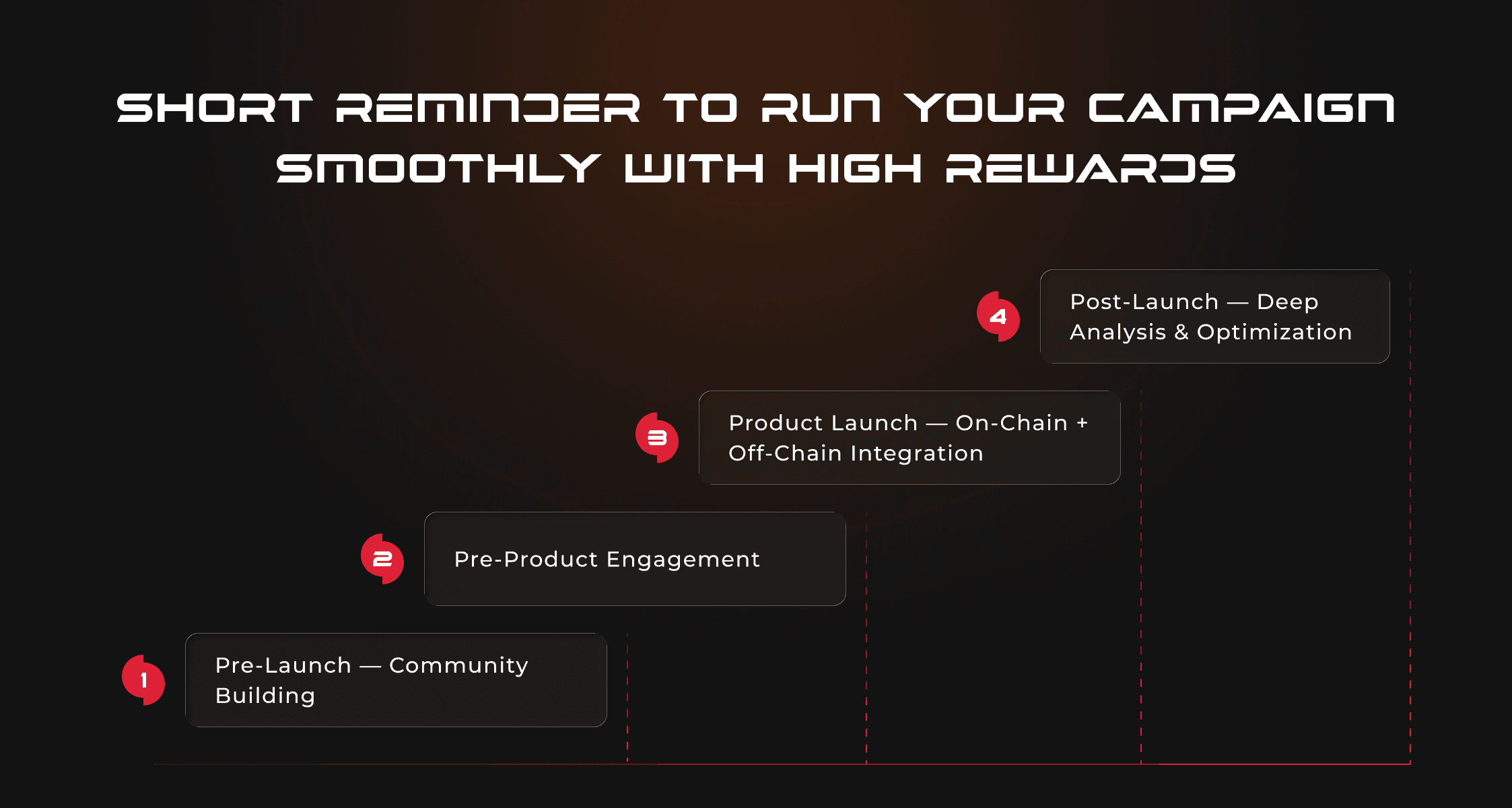
Before users connect their wallets, they interact with your project off-chain: social media, Discord, Reddit, and influencer content.
Key metrics to track:
Community activity: growth of Discord/Telegram, active members, message frequency, sentiment.
Wallet scraping: track which wallets exist, balances, participation in DeFi, and engagement with airdrops.
Early interactions: pre-registration pages, waitlists, pre-deposits, or other pre-launch activities.
At this stage, you’re assessing how engaged and “investable” your community is even before the product exists.
Many projects create transitional experiences before the full product launch: teaser sites, tutorials, mini-games, or pre-deposit mechanics.
Metrics to watch:
Wallet connections and early interactions with dApps or test platforms.
Community actions that indicate intent (e.g., completing tasks, claiming early tokens).
Conversion from curiosity to commitment: how many users move from off-chain channels to interacting with your on-chain assets.
This stage provides early signals of adoption potential and shows which users are likely to convert into real stakeholders.
Once the product goes live, you combine off-chain metrics with on-chain data. On-chain tracking is the real differentiator in Web3: every wallet interaction, token swap, or staking action is a measurable “conversion with skin in the game.”
On-chain metrics to track:
Wallet interactions: new wallets connecting, transactions executed.
Token swaps and claims: did volume spike after announcements or AMAs?
Staking participation: are users committing long-term value to your protocol?
Historical wallet analysis: account age, balances, and past on-chain activity (excluding exchange wallets).
Off-chain metrics to track:
Social engagement: website traffic, influencer-driven traffic, tutorial video views.
Community growth: new members, discussion quality, community-generated content (memes, tutorials, advocacy).
Attribution: link off-chain engagement to on-chain actions to see which campaigns actually drive transactions.
The beauty of on-chain metrics is transparency. Unlike Web2, where tracking often requires expensive databases, in Web3 you can see exactly what connected wallets are doing.
After launch, ongoing measurement combines both on-chain and off-chain insights:
Retention and usage patterns: frequency of wallet interactions, staking behavior, repeated token swaps.
Community health: active members vs. total users, sentiment, content creation trends.
Campaign effectiveness: which off-chain campaigns (tutorials, AMAs, influencer posts) actually resulted in measurable on-chain activity.
This phase ensures your marketing drives meaningful engagement, belonging, and real value transactions.
Schedule a call

“ROI” in Web3 can be a wild concept.
You spend two weeks crafting a marketing campaign, drop it on X, and suddenly see your token chart do a moon-and-crash pattern worthy of a telenovela.
So how do you know what actually worked?
Forget perfect math.
The goal here is to track patterns that connect your marketing efforts to total value created.
That might be new users, more holders, or higher total value locked in your protocol.
Here are a few models that help you make sense of it.
If your project has a token, this is your first stop.
Check how many unique wallets hold your token before and after each marketing campaign.
That’s your user acquisition curve in crypto form.
Ask yourself:
Is the number of unique holders going up steadily?
Are whales accumulating or are tokens spreading to new wallets?
Are people holding or dumping right after incentives?
More unique holders means more decentralized reach. And more long-term belief in your project.
In blockchain marketing, that’s your version of customer retention.
Here’s where you measure the life of your ecosystem.
If your marketing strategies create noise but no sustained engagement, they’re not working.
To test engagement health:
Watch how many people join vs. stay active.
Look for new contributors — developers, designers, or even community mods.
When your users start contributing without being paid, that’s your best possible ROI.
No Google Analytics metric can measure that, but you’ll feel it when it happens.
Even in Web3, the old business question still matters: are we making money?
Your marketing efforts might drive mints, staking, or dApp usage.
So track your revenue-like metrics:
Transaction volume growth after a campaign
Conversion rate from site visitors to wallet users
Fees earned or liquidity added during specific periods
The hardest part here is attribution. Wallets are anonymous, and users jump across platforms. But you can still spot trends: if TVL spikes after a specific campaign, you know you did something right.
For DeFi and staking projects, Total Value Locked (TVL) is your holy metric.
It tells you whether people trust you enough to lock their money into your system. And that is a far stronger signal than likes or shares.
But be careful: temporary liquidity from “farmers” doesn’t mean real growth.
Track:
How long assets stay locked
Which marketing channel brought in the new users
Whether total value holds steady once rewards stop
Consistent TVL = trust.
Flaky TVL = incentive-chasers.
And that’s how you tell if your marketing campaign actually worked or just inflated your chart for a week.
Now, let’s take a look at the Web3 tools you need to measure the success of your campaigns.
What it does & why it matters
Addressable is built for exactly the kind of cross-channel, on-chain/off-chain mix that Web3 demands: it lets you track audiences, target wallets, and tie ad impressions or website visits to actual on-chain conversions (token swaps, protocol interactions).
For example: you run a display ad → someone visits your landing page → they connect their wallet → they mint an NFT or provide liquidity. Addressable can help you follow that full chain.
It also supports targeting high-intent wallets (e.g., those already holding specific tokens, or participating in DeFi), so you’re not just throwing marketing efforts into the nothing.
How it links to your key metrics
You can measure “number of unique wallets” that came in via a campaign → that is your user acquisition in crypto.
You can tie that to on-chain conversions (swaps, staking) → which helps you calculate real conversion rate (not just clicks).
Because you’ve got wallet-level data, you can segment by wallet behavior (e.g., new user vs whale) and optimize your marketing channel accordingly.
If you see many wallets connected but few transacted, you’ve identified a drop-off point in your funnel (off-chain → on-chain) and can optimize for it.
What it does & why it matters
Spindl is focused on attribution and analytics for Web3. It links off-chain ad impressions (Web2) to on-chain actions (Web3) in a way that helps you figure out which influencer posts, which referral campaigns, or which token-drop drove real conversions.
They’ve partnered with AppsFlyer (a big name in traditional marketing analytics) to bridge Web2 and Web3 data flows.
How it links to your key metrics
If you run a campaign and want to know: “Which channel gave us the best ROI in terms of on-chain actions?” — Spindl helps you answer that.
You can measure the marketing campaign contribution to actual “real world” conversions: e.g., wallet connects → token swaps → liquidity provided.
You can optimize marketing strategies by looking at which messaging/creative/influencer generated the highest quality wallets (i.e., those that stick and transact) rather than just lowest cost per click.
What it does & why it matters
Formo is billed as a “privacy-first cross-chain analytics” platform for Web3 marketing intelligence. It emphasizes multi-chain support, wallet-level segmentation, and tying off-chain touchpoints to on-chain behavior.
It supports features like token-gated forms, on-chain CRM, and audience segmentation by wallet holdings or DeFi usage.
How it links to your key metrics
You can measure how many wallets came in via your website or content campaign, how many interacted with the product, and how many locked value in your protocol (TVL growth).
Because it supports real-time and cross-chain attribution, you can optimize conversion flows and marketing channels more quickly (reduce CAC, boost ROI).
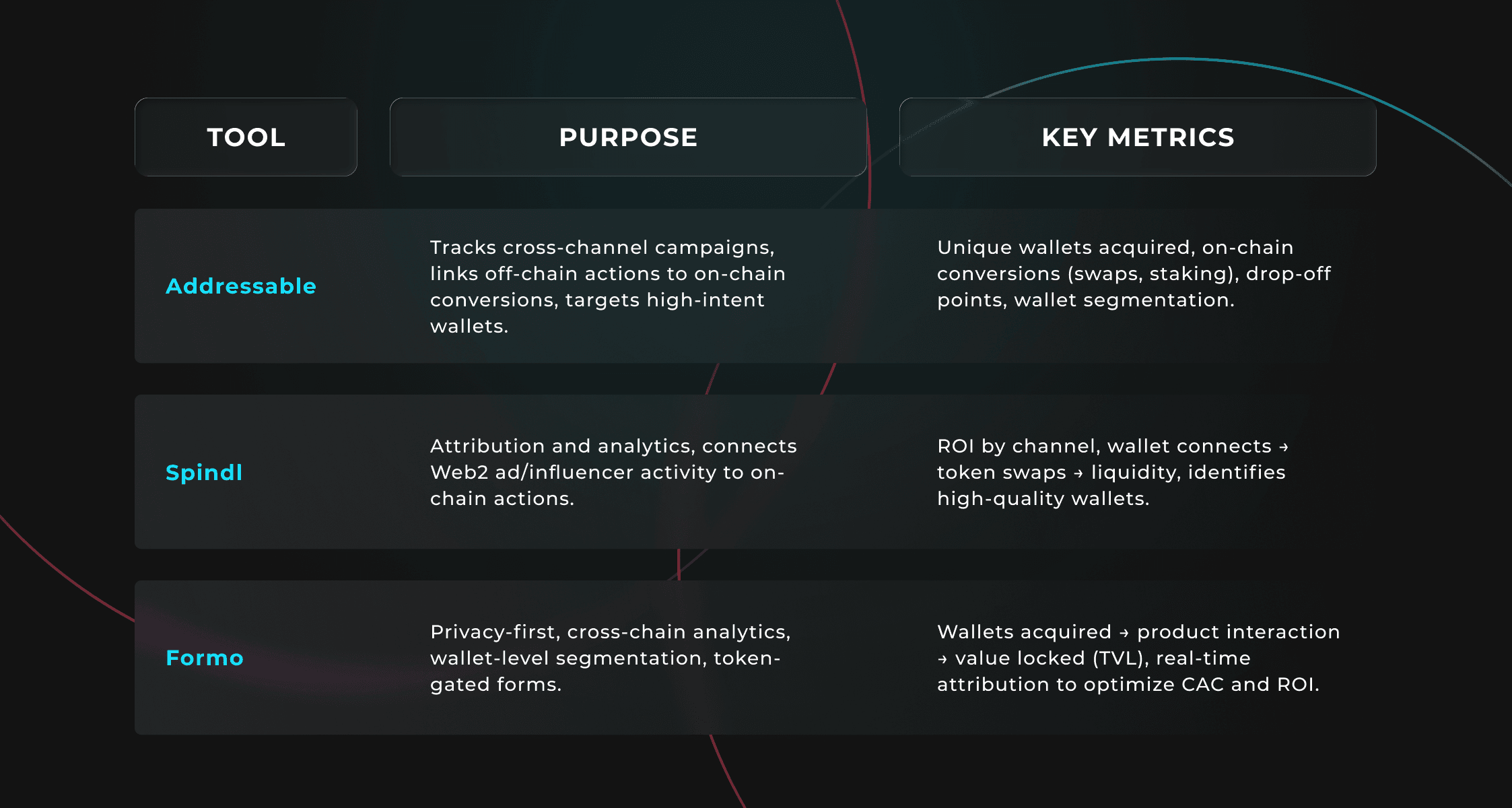
Tracking your Web3 marketing results is all about seeing real cause and effect.
If you want to measure the success of a web3 project, you have to track the right stuff:
On-chain metrics (wallet connects, swaps, NFT mints, number of unique wallet addresses)
Off-chain signals (Discord chatter, website traffic, posts on social media platforms, even email marketing opens)
Think of tracking as your translation layer between digital marketing habits (how people find you) and blockchain behavior (what people actually do once they find you).
Without Web3 attribution, you won’t know which marketing activities truly moved people from casual browsers to actual users.
Good marketing analytics answer questions like:
Did that influencer drop lead to more unique wallet addresses interacting with the dapp? Did TVL rise after the campaign? Which channel gave the best return on investment - the Telegram AMA, the paid ad, or the newsletter?
That’s how you stop burning tokens on noise and start building data-driven marketing that grows the web3 ecosystem for the long run.
Measuring KOL campaigns in Web3 is tricky because the hardest part is tracking the actual contribution of each influencer.
Ways to measure effectiveness:
Affiliate-style tracking: For products that can support it (staking, token-gated actions), assign a unique referral code or link to each influencer. This lets you tie on-chain actions back to a specific KOL.
Unique access codes or links: Providing unique codes not only motivates the influencer’s audience but also allows you to track conversions precisely.
Specialized micro-communities: Encourage influencers to run dedicated communities or giveaways for their audience. This helps isolate engagement and measure impact on your project without overlap.
Monitor engagement quality: Beyond clicks or follows, track wallet connections, token swaps, or staking activity generated by the influencer’s audience.
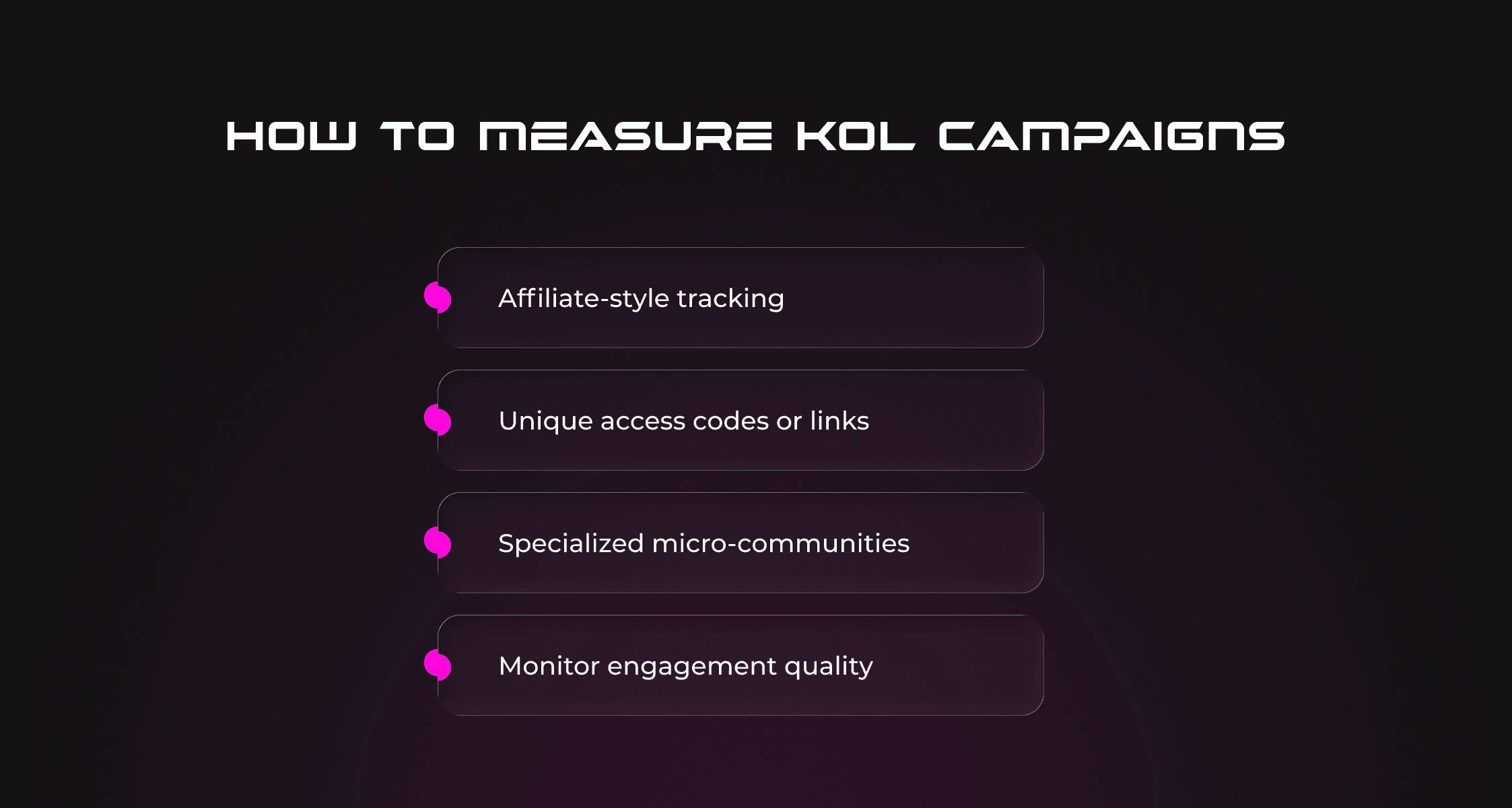
The goal is to move beyond vanity metrics and measure real, on-chain value generated by each influencer.
Once you have the data, you need the right tactics to improve the numbers. Discover the top 13 crypto marketing strategies to apply these insights effectively.
Ambassadors are the people who help your community grow, drive conversations, and actually make impact. Measuring them is about real action, not only sign-ups.
Who’s active?
Start by looking at how many ambassadors actually do something meaningful. It could be writing a post, translating an article, or creating content. For most mid-sized projects, even 1% of your community doing something useful is a solid baseline. Bigger communities may see lower percentages, smaller ones slightly higher — and if you’ve got big funding, expect higher standards.
External engagement
Ambassadors should amplify your content. On Twitter or other platforms, check that they’re liking, commenting, and reposting. Ideally every ambassador interacts with your content in some way. Comments and reposts usually sit at about a third of likes; if it’s less, your ambassadors aren’t motivated enough.
Quick response actions
Sometimes you’ll need ambassadors to act fast: share a news update, push a narrative, or support a launch. A healthy program sees around 60–80% of ambassadors responding within a day, depending on task complexity and incentives. If they ignore you, it’s a clear sign you need to rethink motivation.
Community chatter
Ambassadors live in the community. Watch how they drive conversations in Discord, Telegram, or local-language groups. Are they starting discussions? Answering questions? Mentioning your new features or events? The more active they are, the healthier your community becomes.
Post frequency
Finally, look at how often ambassadors post. A small account might do 2–3 posts per month, while bigger accounts should be posting more. Too little activity signals disengagement; too much could mean spam.
Track both Web2 and Web3 data. Use Google Analytics or other marketing tools for site funnels, and use Dune Analytics/on-chain dashboards for actual blockchain events.
Focus on metrics that matter: number of unique wallet addresses, unique wallet addresses interacting, conversion rate from site visit → wallet connect → transaction, TVL, and community engagement metrics.
Use Web3 marketing attribution to link influencer posts, social pushes, or email blasts to real on-chain outcomes. That’s how you measure ROI and optimize your marketing strategies.
Don’t copy-paste traditional marketing KPIs blindly; adapt them. Some traditional marketing KPIs still apply (CTR, conversion rate), but you must add blockchain-specific measures for campaign effectiveness.
Be practical: define the funnel (awareness → website traffic → wallet connect → action), set relevant metrics, run analysis of campaign performance, and iterate. That’s how successful marketing in the web3 space looks.
Contact us
Key metrics combine off-chain and on-chain signals: website traffic, social engagement on social media platforms, email open/clicks, plus blockchain events — number of unique wallet addresses, unique wallet addresses interacting, token swaps, NFT mints, staking deposits (TVL), and DAO participation.
Yes. You can run Web2 marketing analytics for page funnels and ad performance, and separate Web3 marketing analytics for on-chain behavior. Combine them with Web3 attribution tools or analytics tools (like Dune Analytics, on-chain attribution platforms, or specialized marketing services) to connect the dots. Some teams use hybrid dashboards to measure campaign effectiveness end-to-end.
Start with the basics: Google Analytics (for site funnels) + a product analytics tool (Mixpanel, Amplitude, or PostHog). For Web3: Dune Analytics for custom on-chain queries, plus Web3 attribution vendors and web3 tools (Safary, Spindl, Addressable, Cookie3, Formo — depending on what you need). For community signals, monitor Discord, Twitter/X, Reddit, and leverage social analytics.