
15 Min Read

Vlad Zghurskyi
Content Creator
Every cycle has the same moment. The token launches, the Discord explodes, everyone posts screenshots. And then… quietly, people leave.
15 Min Read
Vlad Zghurskyi
Content Creator
Every cycle has the same moment. The token launches, the Discord explodes, everyone posts screenshots. And then… quietly, people leave.
Not all at once, and not dramatically. It looks really like a slow bleed.
Until one day, the “community” is a handful of mods talking to each other.
That post-TGE crash? It’s not bad luck - it’s design.
Before we get into who survives it and why, here’s the short version.
"Research by the Solus Research & Community Team. Insights gathered through Discord interviews, activity analysis, and direct conversations with contributors. Not investment advice."
Our original post is here.

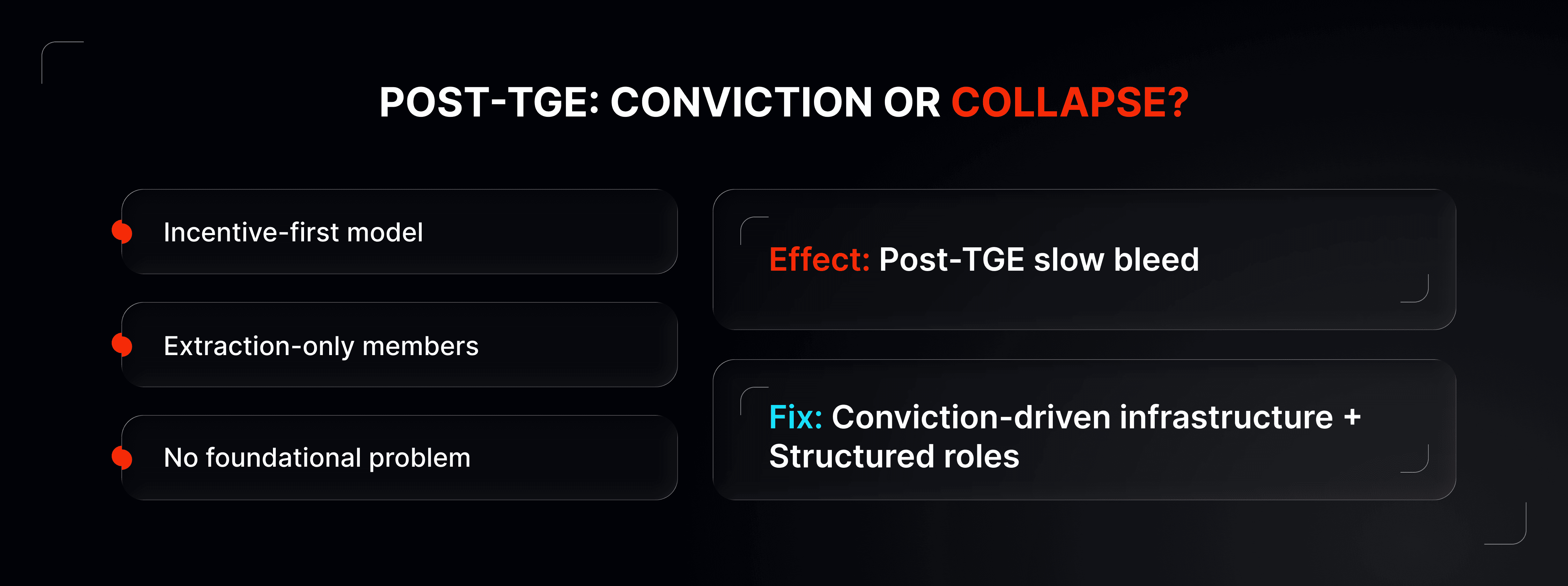
If you’ve been around long enough, you’ve seen it.
If you haven’t… you will.
Most Web3 communities are assembled, they are not formed.
There are points, roles, quests. “Early contributor” badges. So, people show up because there’s something to extract.
And when extraction stops, so does participation.
This isn’t a moral failure or something like that, it’s basic human behavior. If the only reason to stay is a reward, people won’t stay when the reward disappears. Right?
Projects love to ask: How do we keep people engaged post-TGE?
But that's the wrong question.
The right question is: Why would anyone still care if the token didn’t exist?
The communities that survive don’t need constant stimulation.
They’re around not because of some event, but because of an outcome.
They don’t show up for campaigns.
They show up because the problem being solved actually matters.
Especially when investor communities are aligned around long-term infrastructure value rather than short-term liquidity events.
Here’s the simplest filter we know after working through 30+ TGEs:
If rewards stopped tomorrow, who would still care?
Not who would complain or who would lurk.
Who would still show up and push the thing forward?
If the answer is “almost nobody,” the community didn’t fail at TGE, because it was already hollow. The community was never real to begin with.
Schedule a call

Web3 keeps funding variations of the same ideas while foundational problems remain unsolved. New chains, new apps, and new narratives appear every cycle, but the same bottlenecks keep adoption limited. If Web3 wants to function in the real economy, certain issues are unavoidable.
Privacy is mandatory for serious use cases. Performance must match real-time expectations. Computation needs to be verifiable without trust. Cross-chain systems must be usable without technical expertise. And AI ownership cannot default to centralized platforms if Web3 wants relevance in the next decade.
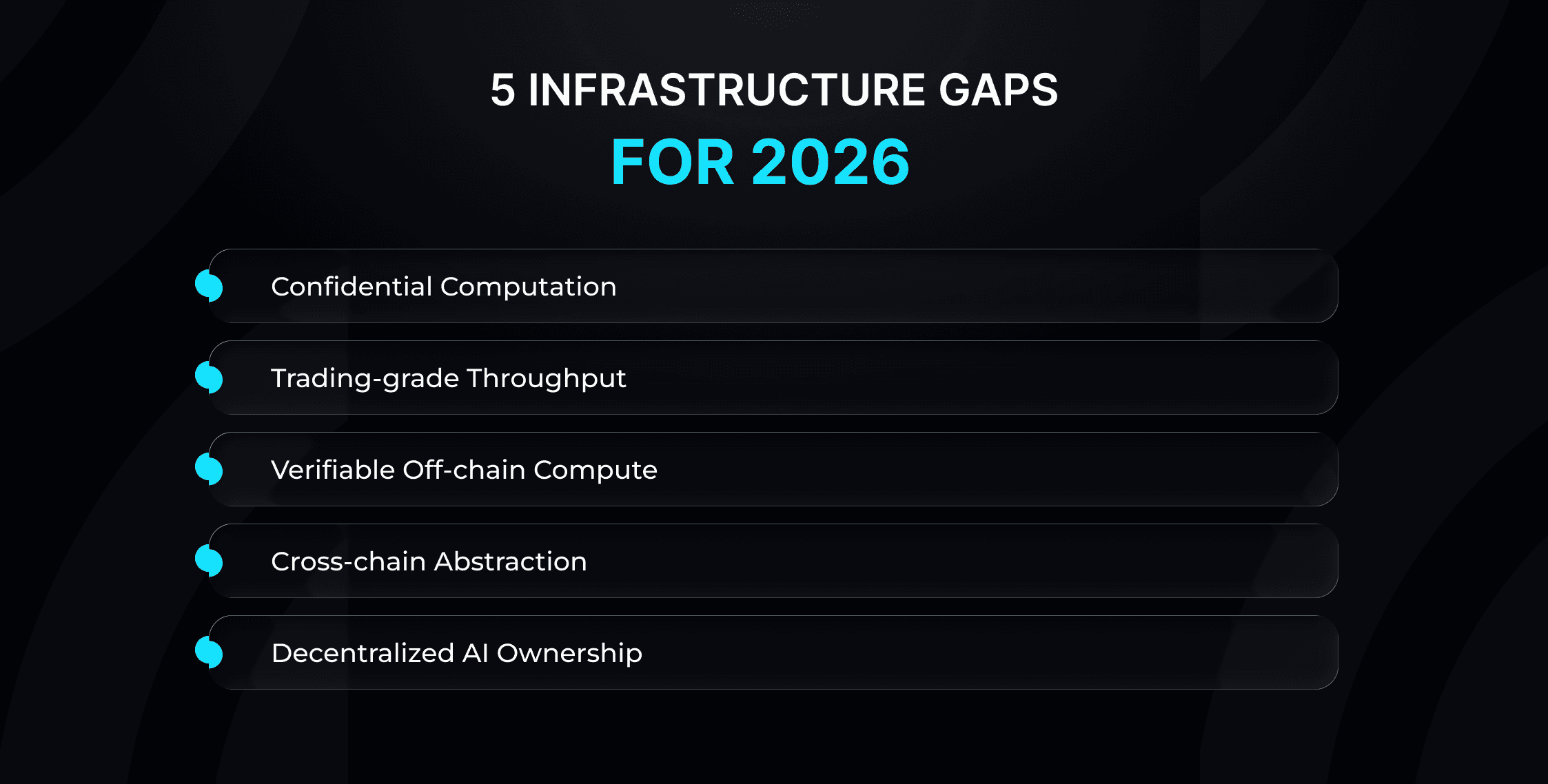
Public blockchains are transparent by default, and that’s a problem. Real businesses can’t operate with every balance and transaction exposed. Finance, healthcare, enterprise - none of them work without confidentiality. Without confidential computation, Web3 stays locked out of serious adoption.
On-chain systems are still slow compared to centralized exchanges. Latency, finality, throughput - traders feel every limitation. If on-chain trading can’t compete on performance, DeFi stays niche. Speed is not some sort of a luxury; it’s a requirement.
Anything computationally heavy gets pushed off-chain. That means trust assumptions sneak back in. If you can’t verify computation, composability breaks. Verifiable computation is how Web3 scales without sacrificing trust.
Users don’t want to think about bridges, gas tokens, or network switching. They want outcomes. The current multi-chain experience is operationally exhausting. Until that complexity is abstracted away, adoption stalls.
AI is becoming the dominant computing layer, and it’s centralized by default. Data, models, governance are owned by a few platforms. If Web3 can’t offer a real alternative, it risks becoming irrelevant during the biggest tech shift of the decade.
These projects aren’t grouped by hype or valuation. They’re grouped by the bottlenecks they’re trying to remove.
PIN AI tackles a simple but uncomfortable truth: today’s AI owns you, not the other way around. Every prompt, every context window feeds centralized platforms. PIN AI flips that model by giving users ownership over their AI agents and data. The community stays engaged because the problem isn’t going away and AI ownership is becoming existential.
Sentient focuses on community-owned AI at scale. Not just open models, but shared governance, shared infrastructure, shared rules. The project attracts contributors who care about long-term control. Their retention comes from purpose in this case.
Zama is working on Fully Homomorphic Encryption for smart contracts. That means computation over encrypted data without exposing it. This isn’t a feature, but a prerequisite for enterprise adoption. Their community understands they’re building something foundational, and that changes behavior.
Inco approaches privacy from a practical angle. Smart contracts that can hide data and logic while remaining verifiable. Confidential by default, transparent when needed. The appeal is obvious to anyone thinking beyond crypto-native use cases.
Fogo is built for one thing: speed. On-chain trading that doesn’t feel like a downgrade from CEXs. Their community isn’t there for vibes; it’s there because performance is DeFi’s biggest weakness. That shared understanding creates long-term commitment.
MegaETH focuses on real-time UX without breaking Ethereum compatibility. Games, social apps, trading - all need instant feedback. The community values quality contribution over grind, which keeps engagement high even without constant incentives.
Nexus makes heavy computation verifiable without running it on-chain. That unlocks entire categories of applications, from AI to complex financial logic. The community forms around collaboration and shared learning, not speculation. That’s why it scales without collapsing.
Doma isn’t inventing a new asset class. It’s bringing one of the oldest digital assets — domains — on-chain. By tokenizing real DNS, it bridges a mature trillion-dollar market into Web3. The community is built around testing and shipping real infrastructure, not farming narratives.
Superform abstracts away multi-chain DeFi complexity. One interface, many chains, clear outcomes. Users don’t join because it’s flashy — they join because it removes pain. Communities built around usability problems tend to stick.
Notice something about these projects? They're not building features. They're solving systemic problems.
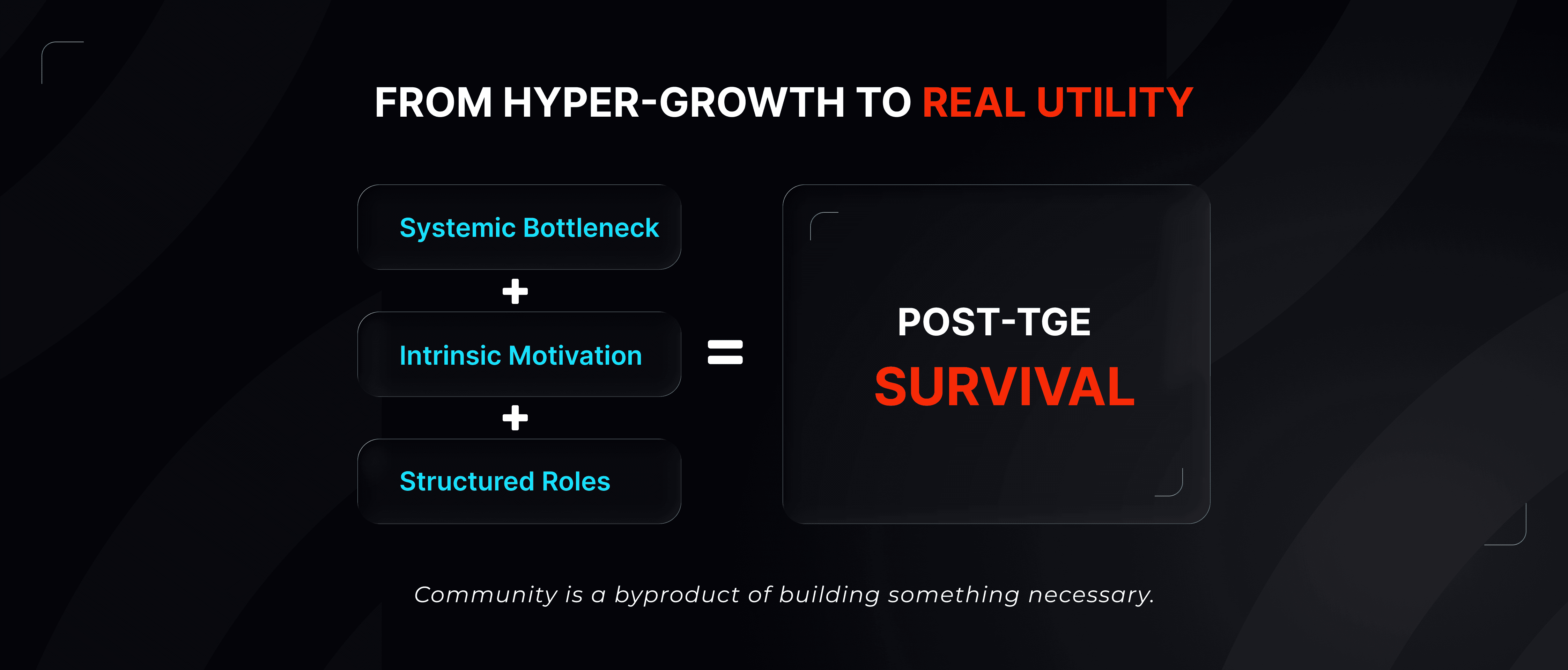
This is the most important common thread across all surviving communities.
None of these projects are chasing trends. They’re addressing limitations that block the entire ecosystem. That creates natural gravity. People stay because the work still matters.
Incentives exist, but they’re not the center of gravity.
These communities don’t revolve around point systems. They revolve around progress. When contribution maps to real impact, engagement becomes intrinsic.
Structure turns belief into action.
Strong communities create responsibility. Regional leads, contributors, creators, these are the roles that matter post-TGE. That structure turns members into stakeholders.
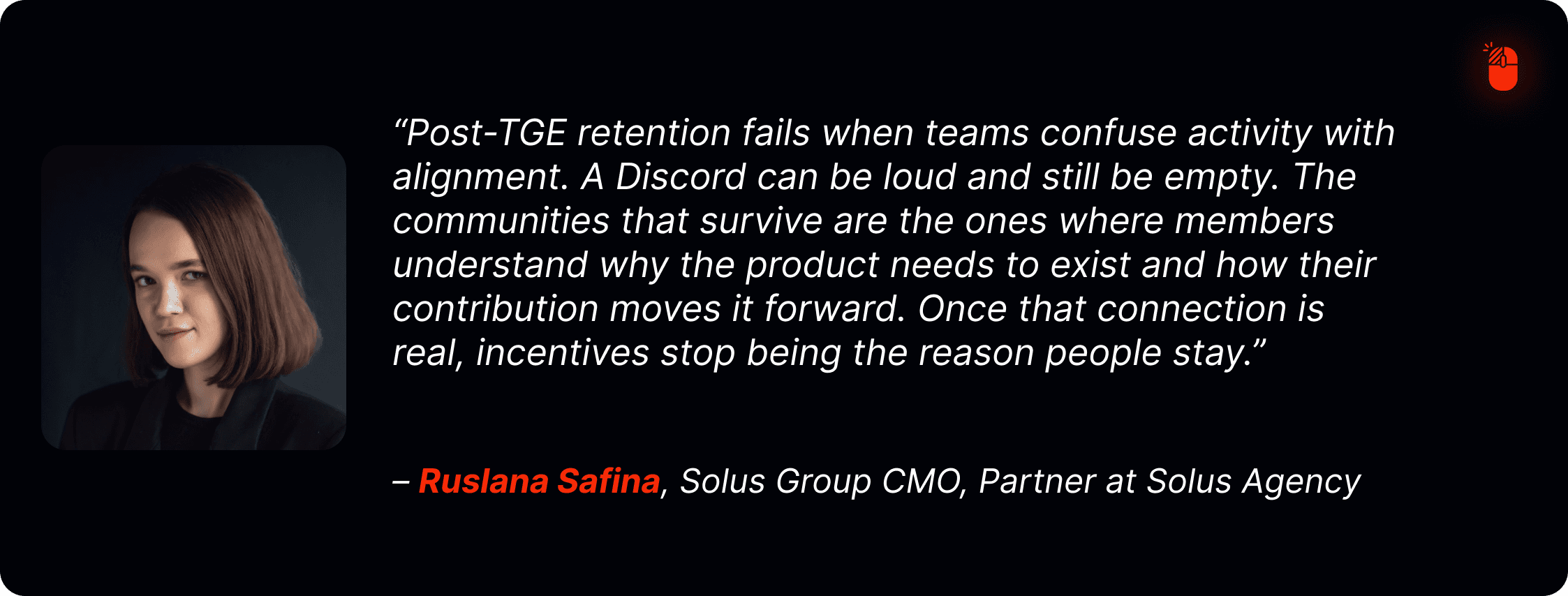
Building this level of hype is impressive, but the real test comes after the token goes live. Read our analysis on why even the strongest communities can struggle after TGE.
Retention starts before launch.
If the problem disappears after launch, so will the community. Pick something that still matters when incentives end.
This determines who you attract and who you repel.
Grinding burns people out. Clear contribution paths pull the right people in and push the wrong ones out.
Titles alone don’t retain anyone.
If roles die after launch, motivation follows. Responsibility creates ownership.
Engagement should reflect reality, not hype.
Engagement should reflect what’s being built. Otherwise, it’s just noise.
Listening without action destroys trust. Communities stay when feedback turns into action.
Post-TGE community retention has nothing to do with bigger airdrops and everything to do with conviction.
The communities that survive are built around infrastructure problems Web3 must solve, not narratives.
Incentive-first communities collapse the moment rewards slow down.
The strongest projects in community-driven Web3 projects 2026 are solving privacy, performance, compute, AI ownership, and usability gaps.
Community is a byproduct of building something necessary.
Let’s talk
Because they were built on incentives, not alignment. When points, quests, and airdrop mechanics disappear, participation drops. Without a deeper reason to stay ( like solving a meaningful infrastructure problem) the community slowly dissolves.
Survivors share three traits:
They solve systemic problems (privacy, compute, AI ownership, performance).
They create contributor paths instead of grind loops.
They design post-TGE roles and structure before launch.
No. Airdrops are powerful acquisition tools.
The mistake is assuming acquisition equals retention.
Without structured filtering and long-term engagement systems, airdrops simply attract short-term participants.