
15 Min Read

Vlad Zghurskyi
Content Creator
113 Token Launches, $1.3B Raised: The Data-Backed 2026 Token Launch Strategy | Solus
15 Min Read
Vlad Zghurskyi
Content Creator
113 Token Launches, $1.3B Raised: The Data-Backed 2026 Token Launch Strategy | Solus
You did everything right.
You raised money. Real money.
Tier-1 VCs.
A Discord with more emojis than humans.
Prime exchange listing.
Launch day opens green. Twitter screams. Champagne GIFs everywhere.
And then reality shows up.
In our previous piece, we exposed the 0.96× problem: in 2025, the average token is effectively dead from Day 1. Not after a crash. Not after unlocks. Day one.
This time, we went further.
We analyzed 113 token launches from 2025, representing $1.3B+ raised, and tested every variable founders obsess over. Funding size. Followers. Platform choice. Sector. Pricing.
The conclusion is worse than “the system is broken.”
Most of what founders optimize for does not matter at all.
Solus Growth / Solus Research worked across 30+ TGEs, multiple cycles of Web3. This piece reflects field research.

Let’s kill the sacred cows first.
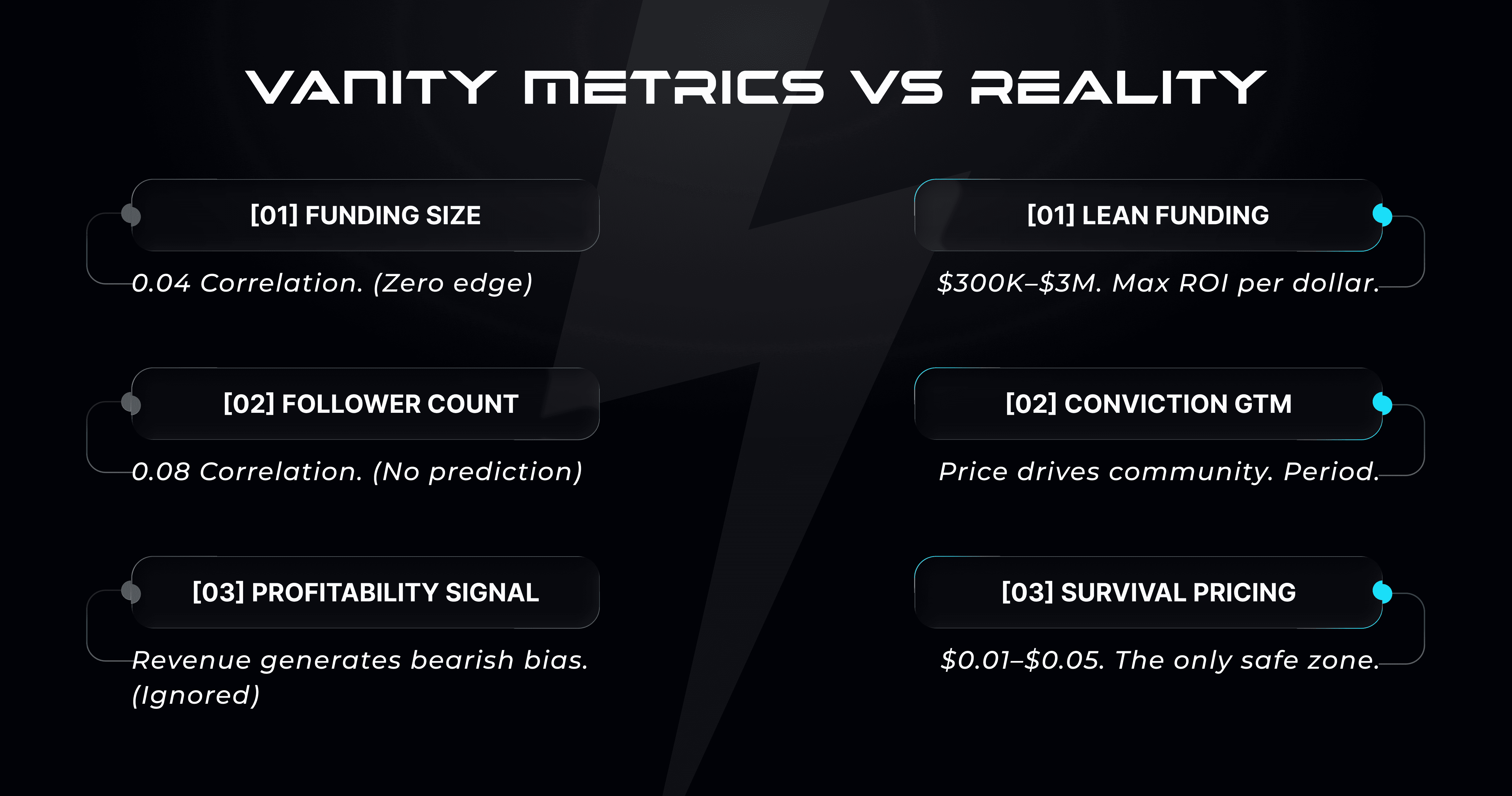
Correlation between funding raised and token performance?
0.04.
That’s not “weak.” That’s statistically meaningless.
Projects that raised $10M+ performed identically to those that raised $1M. On the scatter plot, ROI is just noise, there is no trend, no edge, no reward for capital.
Some of the best performers at ATH — 10× to 30× — raised between $300K and $3M
Meanwhile, heavily funded projects like Boundless and Analog barely touched 1×.
Current performance is even uglier. Most tokens, regardless of funding size, cluster below 1×. Projects that raised $5M–$100M sit at 0.1×–0.7×, indistinguishable from underfunded peers.
Here’s the part founders hate hearing:
Big raises don’t extend your runway. They accelerate your death.
Lean teams move faster, pivot cheaper, and aren’t crushed by quarterly VC unlock schedules that nuke charts on autopilot. If you’re chasing a $10M round to “compete,” you might be optimizing for failure.
500K followers.
50K followers.
Same outcome.
Correlation:
0.08 at ATH
–0.06 current
Translation: your audience size predicts nothing.
Large communities moon sometimes and die often. Small communities do the exact same thing. Why?
The answer is because your Discord isn’t a community, but a speculative audience waiting for liquidity.
Price drives the community — not the other way around.
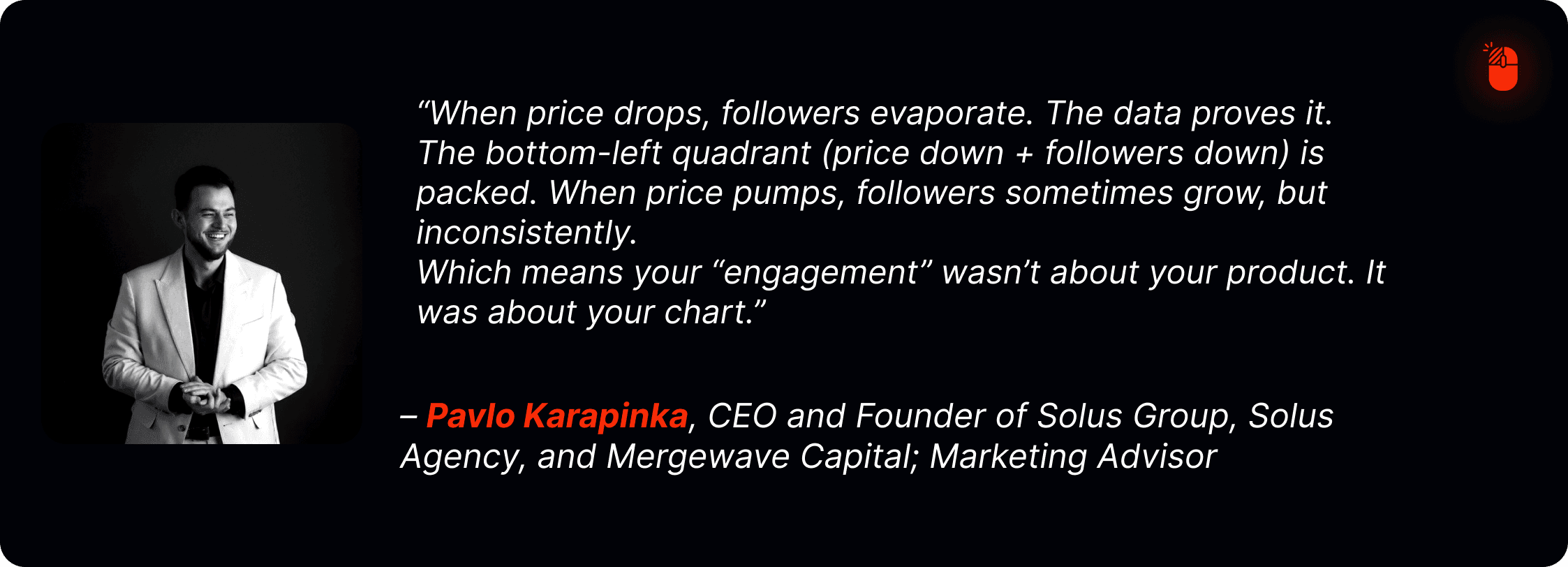
That’s why founders burn 60% of budgets on Discord bots, giveaways, and KOL shoutouts — chasing a metric that statistically does not matter.
Ask yourself one honest question:
How many would stay if your token dropped 50% tomorrow?
You already know the answer.
This is the most dangerous finding.,Projects with real revenue trade lower than projects with none.
Let that sink in.
As DeFi Researcher & KOL @Eli5DeFi said it:
"Revenue generation is currently a bearish signal. Projects that make money are trading lower than those that don't. This dynamic is existential. The industry cannot survive if it continues to punish profitability and reward vaporware."
If markets punish profitability and reward vaporware, the system selects for the wrong builders. And long-term, that system collapses.
Which brings us to pricing — the silent killer almost everyone gets wrong.
Audit your strategy

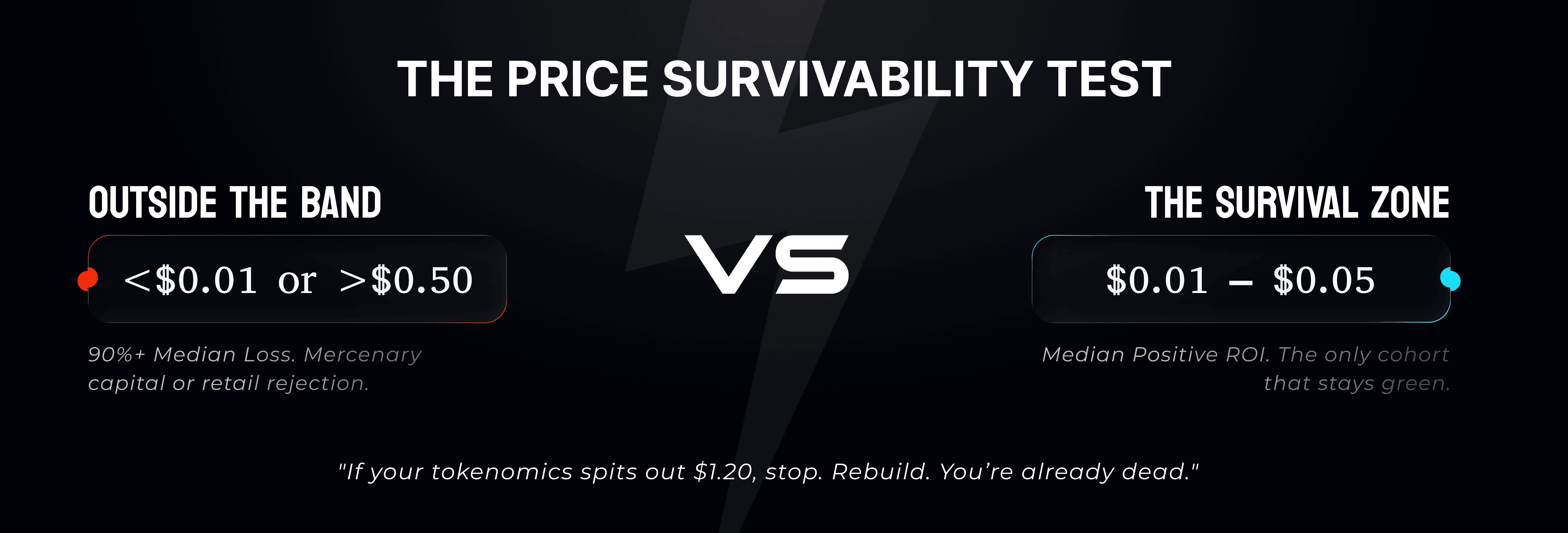
Median ROI by launch price:
Under $0.01 → 0.10× (90% loss)
$0.01–$0.05 → 0.80× (only survivable zone)
$0.05–$0.50 → 0.50×
Above $0.50 → 0.09× (91% loss)
Incredible, right?
Below $0.01 doesn’t make you “accessible.”
It makes you a penny stock.
That attracts mercenary capital that pumps fast, exits faster, and leaves nothing behind.
Above $0.50 doesn’t make you “premium.”
It makes you overpriced.
Retail won’t touch it. Whales wait. Liquidity never forms.
This range does two things at once:
Signals legitimacy
Preserves upside
Out of 97 projects analyzed, 42 in this band were the only cohort with median positive performance.
If your tokenomics spit out $0.003 or $1.20, stop. Rebuild. The data says you’re already dead.
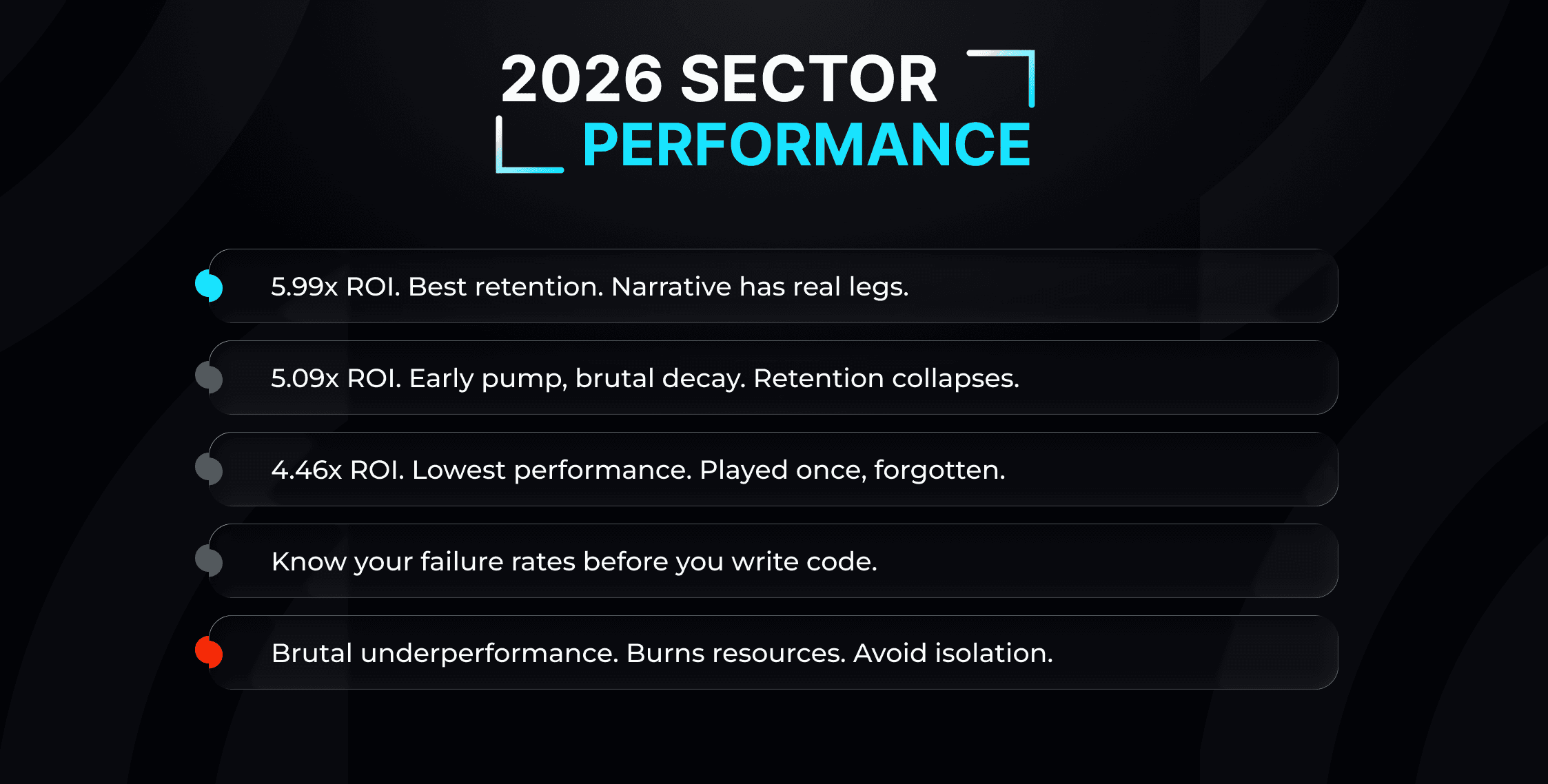
Avg ATH ROI: 4.46× (lowest)
Median current ROI: 0.52×
GameFi tokens are lottery tickets. Played once. Forgotten forever.
Avg ATH ROI: 5.09×
Median current ROI: 0.20×
DeFi looks great early — then retention collapses. Hard.
Avg ATH ROI: 5.99×
Median current ROI: 0.70×
AI holds value better. The narrative has legs. Capital follows — but only if execution is real.
Infrastructure projects? Brutal. You burn more resources than an AI agent dApp and still underperform sectors everyone mocks.
The data doesn’t care about your vision deck.
Founders love believing that platform curation equals safety.
But… it doesn’t.
Across IDOs, almost everything is red.
The only positive average? ImpossibleFi at +14.6% across five launches.
Everything else bleeds –70% to –93%.
Your “premium launchpad” didn’t protect buyers. It just branded the loss.
IEOs show the same trick.
Yes, Binance Wallet shows 11× — across three launches.
Yes, MEXC shows +122% — still an outlier.
The base rate is negative.
Platform selection doesn’t save bad tokens — and increasingly, it doesn’t save good ones either.
Which leads to real failure.
The system didn’t fail in one place you might assume.
It failed everywhere.
What broke: uncontrolled dumping into thin liquidity.
What’s needed: real depth, real modeling, real MMs.
What broke: “Raise on a PDF, figure it out later.”
What’s needed: capital that demands revenue logic, not just narrative.
What broke: paid shills renting audiences.
What’s needed: aligned stakeholders who don’t disappear when payments stop.
Short-term KOL bursts don’t build markets. They spike charts and disappear. Sustainable distribution requires structured, long-term creator alignment, where incentives are tied to product growth, not one-week impressions. That’s the difference between rented attention and engineered positioning.
What broke: assuming hype attracts institutions.
It doesn’t.
Institutions wait for proof.
What broke: mistaking Telegram users for retention.
What’s needed: founder networks, advisors, peers who’ve survived cycles.
The data shows that the period immediately following a TGE is the most dangerous for your user base. Learn why communities often die after launch and how to prevent it.
If you’re designing a token launch strategy for 2026, this is the minimum:
Highest ROI per dollar lives here.
Everything else statistically dies.
If you can’t explain your token in one sentence, it doesn’t need to exist.
Wallet activity, retention, revenue per user. Everything else is noise.
Know your failure rates before you write code.
M&A is a good strategy here, as simple as that.
You already know most of this.
That’s the issue.
The problem isn’t knowledge.
It’s execution infrastructure.
Where do you find non-predatory capital?
How do you build distribution without burning $200K on KOLs?
Who handles acquisitions instead of another doomed raise?
Most founders hit these walls alone.
The survivors didn’t.
They built infrastructure before they needed it.
Funding size doesn’t matter. $10M raises perform the same as $500K ones. Correlation is basically zero.
Community size is a vanity metric. Followers don’t predict price. Price predicts followers.
Profitability is punished. In 2025 data, revenue-generating projects trade worse than vaporware.
Most launch prices are wrong. Only one price band consistently survives.
Platform “prestige” doesn’t protect ROI. IDO/IEO selection is a lottery with better branding.
Talk to us
No. Across 113 launches, funding size had near-zero correlation (0.04) with ROI. $10M raises performed statistically the same as $1M raises.
No. Follower count showed no meaningful correlation with performance. Price movement drives follower growth, and not the other way around.
$0.01–$0.05. It’s the only band with consistently positive median performance. Below that attracts mercenary capital. Above that restricts liquidity.
Lean fundraising, realistic pricing, engineered liquidity, real revenue logic, and aligned distribution infrastructure